
Contents
- Knitting or crochet: which is better for a toy?
- Which yarn is best for knitted toys?
- Which needles and what kit do you need?
- Which stitches do you need for a first knitted toy?
- How do you knit an easy toy, step by step?
- How do you sew up and stuff a knitted toy?
- Is a knitted toy safe for a baby?
- Why is knitting good for the people who knit?
- Frequently asked questions about knitted toys for beginners
- Sources
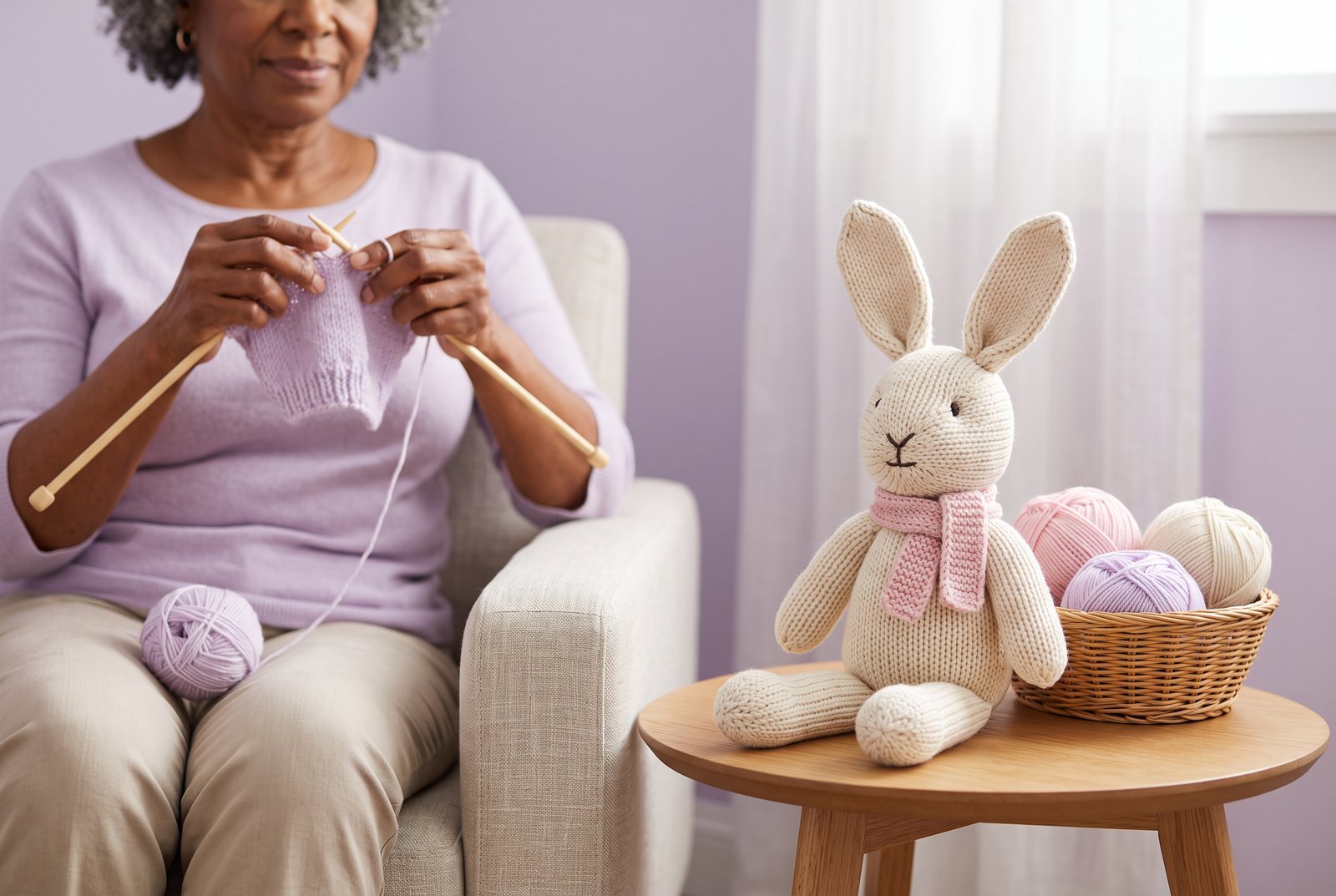
Knitted toys for beginners come down to a few choices: a pattern made of flat pieces in garter stitch, a smooth washable yarn such as DK acrylic or cotton, and needles one or two sizes smaller than the ball band suggests, so the tight stitches hide the stuffing. Knit the pieces, sew them edge to edge, stuff in small tufts, then embroider the face.
A knitted toy has something other soft toys lack: you can see every stitch, and so the time that went into it. The good news is that it needs only two basic stitches. The rest is down to the yarn, your tension and the sewing up.
Knitting or crochet: which is better for a toy?
Both make lovely toys, but in different ways. Knitting works with two needles and keeps all the live stitches waiting; crochet holds only one at a time, which lets you work in a spiral and sculpt shapes.
Knitting flat
Pieces worked back and forth on two straight needles, then sewn together. The easiest way in for a beginner.
Knitting in the round
A tube knitted on double-pointed needles or a circular needle: fewer seams, but four needles to tame.
Crochet, or amigurumi
Tight stitches in a spiral that form balls directly: heads, bodies and legs with hardly any sewing.
The word amigurumi comes from Japanese: “ami” means knitted or crocheted, “nuigurumi” a stuffed doll. Today it mostly means small, round, very tight crochet characters. One trap for British crocheters: most amigurumi patterns online use US terms, and a US “single crochet” is what UK patterns call a double crochet. If you already knit, start with knitting: you keep your bearings. To see what each technique gives, compare our knitted plush with our crochet plush: knitted stitches stay softer, crocheted ones more sculpted.
Which yarn is best for knitted toys?
For a first toy, one simple rule: a smooth, light-coloured yarn that goes in the washing machine. Smooth, so you can see your stitches and spot a mistake. Light, because a stitch in black yarn is almost invisible in the evening. Washable, because a toy always ends up needing it. A double knitting (DK) weight is the easiest to handle; 4 ply makes smaller, finer toys, and aran or chunky bigger, softer ones.
| Yarn | Feel | Stitches | Care | Best for |
|---|---|---|---|---|
| Acrylic | Soft, light | Easy to read | Machine washable, does not felt | First toy, everyday comforter |
| Cotton | Cool, a little firm | Very crisp, not very stretchy | Machine washable, dries slowly | Baby comforter, summer toy |
| Superwash merino wool | Warm, supple | Easy to read | Wool cycle | Cuddly toy, new-baby gift |
| Untreated wool | Warm, rustic | Readable | Hand wash, cold water; felts in the machine | Decorative toy |
| Chenille or velvet yarn | Very soft, thick | Hard to count, stitches slip off | Often delicate, check the ball band | Big squishy toy, after a first try |
| Mohair, alpaca, angora | Fluffy | Hidden by the halo | Hand wash | Grown-up toy, not for a baby |
Always read the ball band: it gives the recommended needle size, the tension over 10 cm and the care symbols, the same as on your clothes. Keep it, as it is the only washing guide your toy will have. Fluffy yarns shed fibres that a toddler sucking a comforter ends up swallowing.
Which needles and what kit do you need?
The ball band gives a needle size designed for a jumper, which needs to stay supple. A toy needs to be dense. Go down one or two sizes: for a DK yarn labelled 4 mm, knit on 3 or 3.5 mm needles.
Why knit tightly
Beyond that, you need a pair of straight needles, or a set of double-pointed needles if you knit in the round, a blunt-ended wool needle for sewing up, a few stitch markers, polyester toy stuffing and a little embroidery thread for the face. A small toy takes a single 50 g ball.
Which stitches do you need for a first knitted toy?
Cast on, knit and cast off: with those three moves, you can already make a toy. Knitting every row gives garter stitch, which is thick, stretchy and does not curl at the edges. It is the beginner’s stitch, and the one used in our pattern below.
Stocking stitch alternates a knit row and a purl row. It is smoother and finer, but its edges roll: the seams hide them. Add two more moves and you can shape a head or a tummy:
- the increase, knitting into the front and then the back of the same stitch (kfb);
- the decrease, knitting two stitches together (k2tog).
Always knit a 10 cm by 10 cm tension square with your needles before you start. If you count more stitches than the pattern, your toy will be smaller; fewer stitches, bigger and looser.
How do you knit an easy toy, step by step?
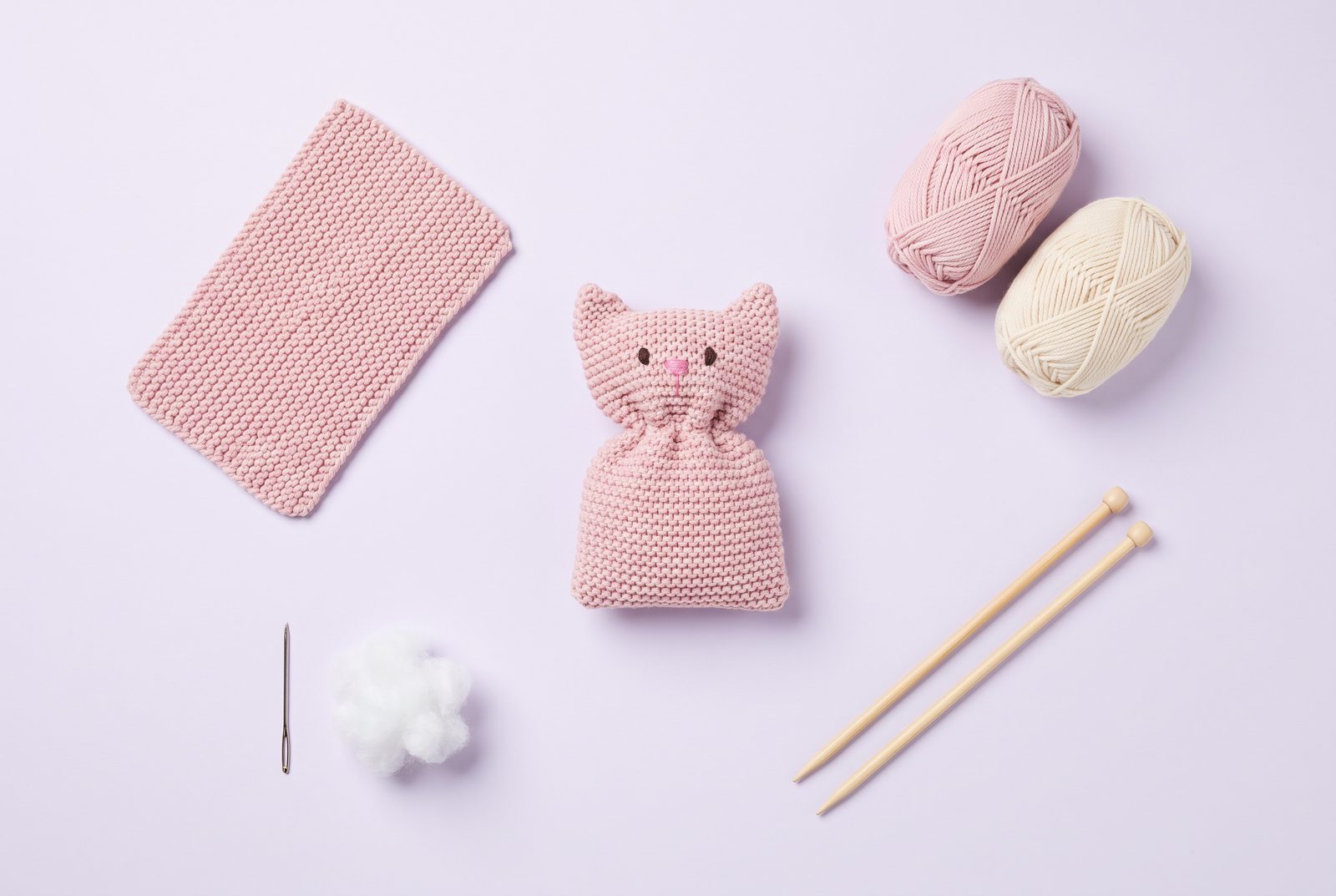
The simplest pattern there is fits in a rectangle. Folded, sewn and gathered in the right place, it becomes a cat or a bear with pointed ears. No maths, no decreases.
The square cat, for a first go
With a DK yarn labelled 4 mm and 3.5 mm needles, cast on 30 stitches. Knit in garter stitch until you have a rectangle about 30 cm tall, then cast off. Fold it in half, like closing a book, and sew up both sides: you get a pouch of about 13 cm by 15 cm.
Stuff it without stretching it, then sew the top. Run a strand of yarn in running stitch all the way round the pouch, 5 cm below the top, and pull gently: the neck appears, and with it the head. The two top corners stand up as ears; a small stitch at their base keeps them upright. Embroider the eyes and nose, and the toy is finished.
Moving on to a bear or a bunny in pieces
Once the rectangle works, the next step is a pattern in pieces: a head, a body, four limbs and two ears, knitted separately and then joined. That is where increases and decreases come in, rounding the shoulders and the head. Pick a pattern in stocking stitch or garter stitch, 20 to 25 cm tall, that gives its tension. Leave whiskers, clothes and tiny accessories for later: they complicate the work without adding anything to the cuddle.
How do you sew up and stuff a knitted toy?
Making up decides how the toy will look. On stocking stitch, use mattress stitch: on each side, the needle picks up the horizontal bar between the first and second stitch, row after row. When you pull, the seam disappears. On garter stitch, sew edge to edge, picking up the little bumps along the edge, alternately on one side and the other.
Stuff in small, teased-out tufts, without packing it: an overfilled knit stretches, the stitches open and the stuffing shows. If your knitting is still a little open, first slip the stuffing into a small pouch of thin fabric in the colour of the yarn. Embroider the face after stuffing, bringing the needle in and out through the back of the head: the knots vanish into the stuffing.
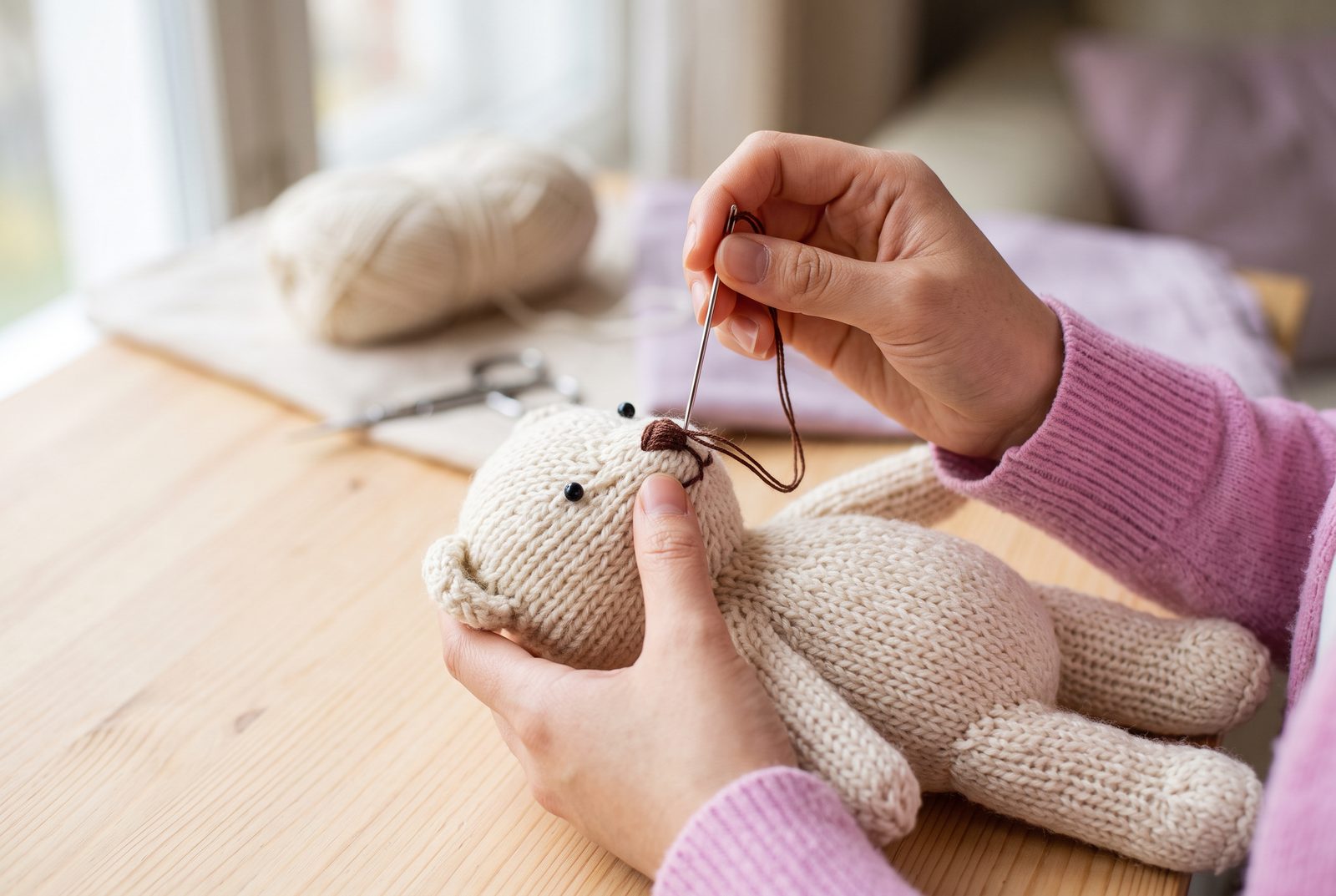
Fasten off each end and weave it in for at least 5 cm, in two directions, through the stitches. A badly woven end eventually works loose and undoes a stitch. If that happens, our tips on how to repair a stuffed toy explain how to catch a stitch before it runs.
Is a knitted toy safe for a baby?
Yes, if it is designed for one from the start. A study of children who choked on manufactured objects found that 65% of those who died were under 3 years (Rimell et al., 1995). So a knitted toy for a little one has no added parts at all: no buttons, beads, plastic eyes or bells. Everything is embroidered.
Knit tightly, so a small finger cannot part the stitches and pull out the stuffing. Avoid fluffy yarns and cords, sew every limb on firmly and tug on each one before you give the toy. Over time, wool pills: remove the bobbles with a comb or a fabric shaver, because a baby would end up chewing them.
For washing, follow the ball band. Acrylic and cotton go in the machine inside a pillowcase; untreated wool washed hot or agitated too much felts and shrinks for good. Always dry flat, reshaping the toy as you go: hung up, a knitted toy stretches. The full method to wash a stuffed toy applies to yours, on the gentle setting.
Why is knitting good for the people who knit?
The old image of a grandparents’ pastime has aged well, and knit and natter groups now meet in libraries, cafés and community halls across the country. A large online survey asked knitters around the world what knitting gives them.
knitters replied: many said they knit to relax, relieve stress and be creative, and the more often they knitted, the calmer and happier they said they felt.
Riley, Corkhill and Morris, 2013, British Journal of Occupational Therapy
The most frequent knitters also reported better cognitive functioning, and knitting in a group improved their sense of happiness and their contact with others (Riley et al., 2013). Among 1,321 people aged 70 to 89 years, craft activities such as knitting or quilting were associated with less mild cognitive impairment (Geda et al., 2011). These are associations, not proof that knitting protects the brain: perhaps people who stay sharp simply keep knitting for longer.
One more modest certainty: a toy knitted for someone is kept for a long time. And if you prefer a sewing machine to needles, our guide to making a plush toy covers everything from the pattern to a safe comforter.
Frequently asked questions about knitted toys for beginners
What is the easiest thing to knit as a beginner?
A garter stitch square or a scarf, because every row is the same. The next easiest is a toy made from that same rectangle: the square cat described above, folded, sewn and gathered at the neck. It teaches casting on, knitting, casting off and sewing up, the four skills every knitted toy relies on.
Where can I find free knitted toy patterns to download?
Yarn makers publish many free patterns on their websites, as do knitting blogs and magazines, and your local library lends pattern books. For a first toy, pick a garter stitch pattern in one or two pieces that gives the tension and the needle size: without those two figures, the finished size is a surprise.
How long does it take to knit a toy?
A 15 cm square cat takes a beginner 2 or 3 evenings, sewing up included. A 25 cm bear knitted in pieces, with a separate head, body, arms and legs, takes more like 1 to 2 weeks at an hour a day. Sewing up and embroidering the face often take as long as the knitting itself.
Can you knit a toy without sewing it up?
Almost. Knitting in the round on double-pointed needles or a circular needle turns the body and head into a single tube, closed by gathering the last stitches. You still attach the ears and arms, unless you pick up stitches for them straight from the body. In crochet, spiral amigurumi goes further still.
Sources
Geda Y.E., Topazian H.M., Lewis R.A., Roberts R.O., Knopman D.S., Pankratz V.S., Christianson T.J.H., Boeve B.F., Tangalos E.G., Ivnik R.J., Petersen R.C. (2011). Engaging in cognitive activities, aging, and mild cognitive impairment: a population-based study. The Journal of Neuropsychiatry and Clinical Neurosciences, 23(2), 149-154. DOI: 10.1176/jnp.23.2.jnp149
Riley J., Corkhill B., Morris C. (2013). The benefits of knitting for personal and social wellbeing in adulthood: findings from an international survey. British Journal of Occupational Therapy, 76(2), 50-57. DOI: 10.4276/030802213X13603244419077
Rimell F.L., Thome A., Stool S., Reilly J.S., Rider G., Stool D., Wilson C.L. (1995). Characteristics of objects that cause choking in children. JAMA, 274(22), 1763-1766. DOI: 10.1001/jama.1995.03530220029027