
Contents
- What is a transitional object?
- Why does a comfort blanket matter so much?
- At what age does a child get attached, and when do they let go?
- My child has no comforter: is that a problem?
- Can you choose the comforter for your child?
- Should you buy a spare comforter?
- Lost comforter: what should you do?
- How do you help a child give up a comfort blanket?
- Frequently asked questions about transitional objects
- Sources
A transitional object is the soft thing, comfort blanket, teddy or scrap of muslin, that a young child picks out and will not let go of. The English paediatrician and psychoanalyst Donald Winnicott described it in 1953: it helps the child cope with a parent’s absence, fall asleep and face new things, then fades away in its own time.
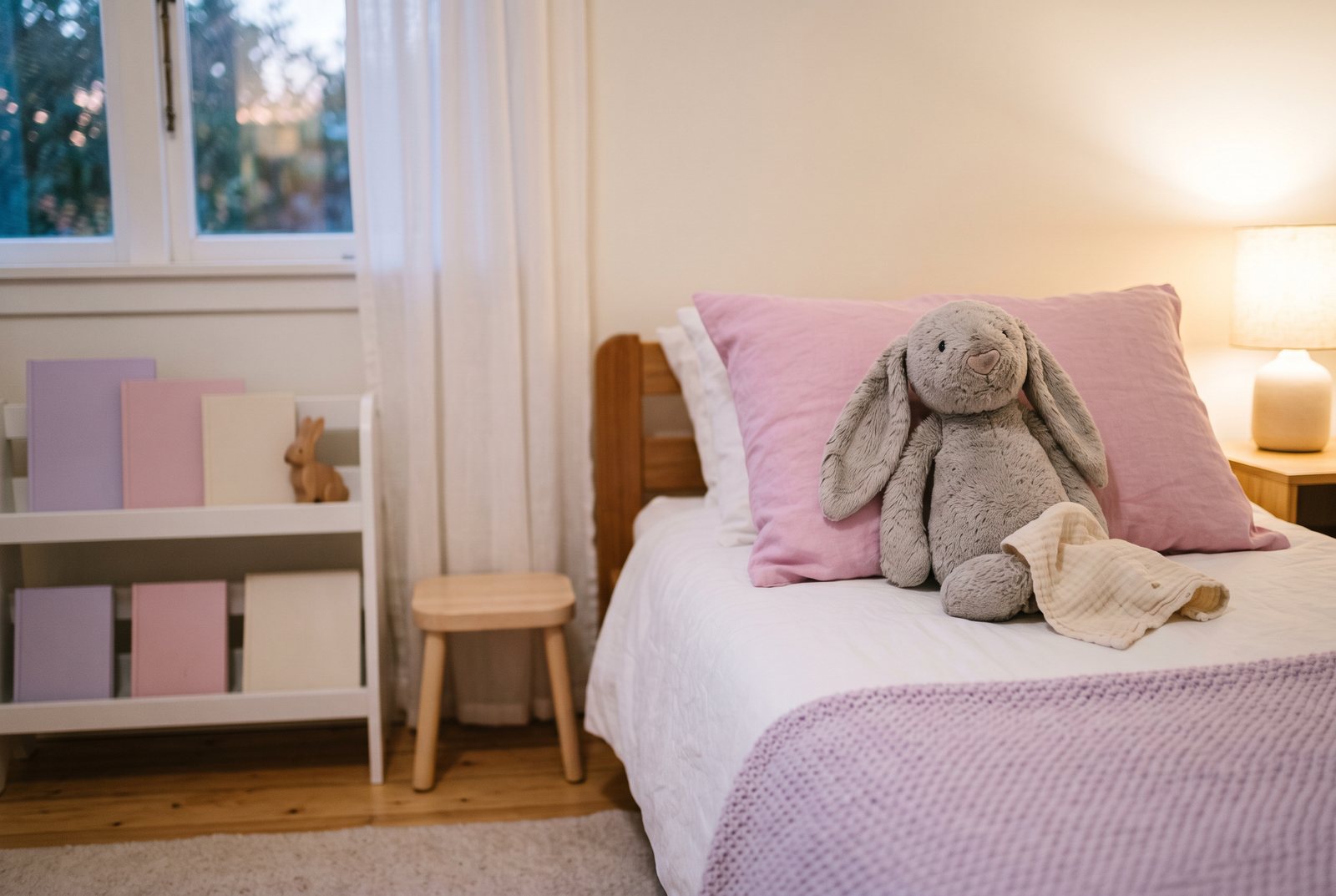
The rabbit with the chewed ear, the blanket that smells only of home, the bear nobody sleeps without. What looks like a habit is one of the first tools your child builds to grow up. Here is what a comforter does, when it arrives, when it leaves, and how to go along with it without tears.
What is a transitional object?
Winnicott called it “the first not-me possession”: the first thing that belongs to the baby without being part of them, or of their mother. It need not be a soft toy. A corner of a blanket, a muslin, a parent’s T-shirt or a satin label rubbed between two fingers do the job just as well.
Two traits set it apart from a favourite toy. The child chooses it, often among things nobody meant for them. And the attachment is real: it cannot be swapped, washed without protest or left at home without tears.
The word “transitional” describes its job. The comforter bridges the gap between a parent’s arms and the outside world, between presence and absence, between day and sleep.
The journey a transitional object helps your child make
Why does a comfort blanket matter so much?
It reassures, above all at the tipping points. You see it in the evening, when your child has to let go to fall asleep. In the morning at nursery, when you leave. At the GP’s, somewhere new, after a fall or a big tantrum. The comforter is squeezed, sniffed and chewed, and calm comes back a little faster.
It also helps with play. The cuddly eats, has a bath, gets told off, goes on holiday: your child replays what they live through, and gets the measure of it.
Should a very attached child worry you? No. In a study that followed children from 12 to 30 months, most of those attached to a blanket or soft toy were securely attached to their mother, at both ages (Lehman et al., 1992). A comforter is not a sign that something is missing.
The comforter: common beliefs and what researchers found
What you often hear
- A comforter makes a child dependent.
- A child with a comforter is an anxious child.
- A child without one is missing something.
- An identical copy will do.
What the studies show
- It helps the child settle alone, then fades.
- Most are securely attached to their mother.
- Genes and the way of falling asleep weigh heavily.
- Young children prefer the original to a perfect copy.
At what age does a child get attached, and when do they let go?
Winnicott placed the first possessions between 4 and 12 months. In practice, many parents see the chosen one emerge towards the end of the first year, when the child grasps that parents can leave, and come back. For sleep, the Lullaby Trust is clear: no soft toys or comforters in a baby’s cot. Under 1, the comforter is shared during awake time and cuddles, and joins the bed later. Our guide on how to choose the right soft toy explains what suits each age.
| Age | What happens | How to help |
|---|---|---|
| Under 4 months | The baby settles mainly through touch, voice and the smell of their parents | No need for a comforter; a soft toy can decorate the room, out of the cot |
| 4 to 12 months | A preference for one soft object begins, often whatever is lying nearby | Offer, never insist; let them have it while awake, not during sleep before 1 |
| 1 to 3 years | The comforter goes everywhere: nursery, car, shops, bed | A spare, a name label, a well-planned wash |
| 3 to 6 years | It stays home more willingly, and reappears in hard moments | Give it a “spot” on the bed, without taking it away |
| Over 6 | It becomes discreet, kept for sleep or for sad days | Never tease, and do not mention it in front of friends |
There is no deadline for giving it up. Many children drift away from it between 3 and 6, but a large Finnish survey shows that a transitional object can last much longer: at fourteen and a half, 29 % of the 1,054 teenagers questioned still had one (Erkolahti and Nyström, 2009).
Teenagers aged fourteen and a half who still had a transitional object
The same study noted slightly more low mood among the girls who had one. Nothing alarming in itself, but a clue: when a forgotten comforter makes a strong comeback in an older child, it sometimes signals a hard patch, and deserves a gentle “how are you doing?”.
And adults? Plenty keep a childhood teddy, or adopt one to unwind. Our article on choosing a stuffed animal for adults talks about it without embarrassment.
My child has no comforter: is that a problem?
No, and it is common. Whether a child gets attached to an object depends partly on the child. In 1,122 pairs of 3-year-old twins, the differences came 48 % from genes and 48 % from the shared family environment (Fortuna et al., 2014).
The way a child falls asleep matters too. Among 126 American infants, those who fell asleep with an adult nearby used an attachment object less often, and sucked their thumb less; where the child slept at night, and how they were fed, mattered less than that presence at bedtime (Wolf and Lozoff, 1989).
Childcare plays a small part as well: in the twin study, children in half-day care had a comforter less often than those in full-day care. A child with no comforter finds other ways to settle, a song, a thumb, a ritual, a corner of the sheet rolled between their fingers. Winnicott called these transitional phenomena: they play the same role, with no object.

Can you choose the comforter for your child?
You can suggest. Your child decides. The future comforter is sometimes one baby gift among many, or the thing that happened to be there on a feverish night; a child may also ignore the planned one for weeks, then adopt it overnight.
What you control is what is within reach. Leave two or three soft, light, safe and washable things nearby: a flat comforter, a small plush animal with embroidered eyes, a muslin. The rabbit plush, with long ears that are easy to grab and rub, is one of the great classics. Then watch which one gets asked for.
Once the chosen one is picked, stick with it, even if it looks tired or comes in a colour you dislike.
Should you buy a spare comforter?
Yes, and as early as possible. The spare still has to be accepted. In an experiment with a fake machine that seemed to copy objects exactly, young children were less willing to accept a copy of their attachment object than of their favourite toy (Hood and Bloom, 2008). To them, that comforter is not a model, it is an individual.
Hence the method: buy the second one as soon as the first becomes the favourite, and swap them every week, so both wear, wash and smell the same. Brought in 6 months later, brand new and stiff, the spare is likely to be found out.
Plan the wash the same way: in on a nursery morning, dry during the day, back in bed by the evening. Our advice on how to wash a teddy bear covers the programme and the drying time.
Lost comforter: what should you do?
First, search methodically, before panic takes over the house. Retrace the day in order: car, buggy, nursery, shop, park. Ring the places that have already closed, as many keep lost property aside. Check the laundry basket, the bottom of the bed and under the sofa cushions, where it loves to hide.
Then prepare for next time. A sewn-in label with a name and phone number, a photo of the comforter on your phone to describe it, and that famous spare tucked away in a cupboard.
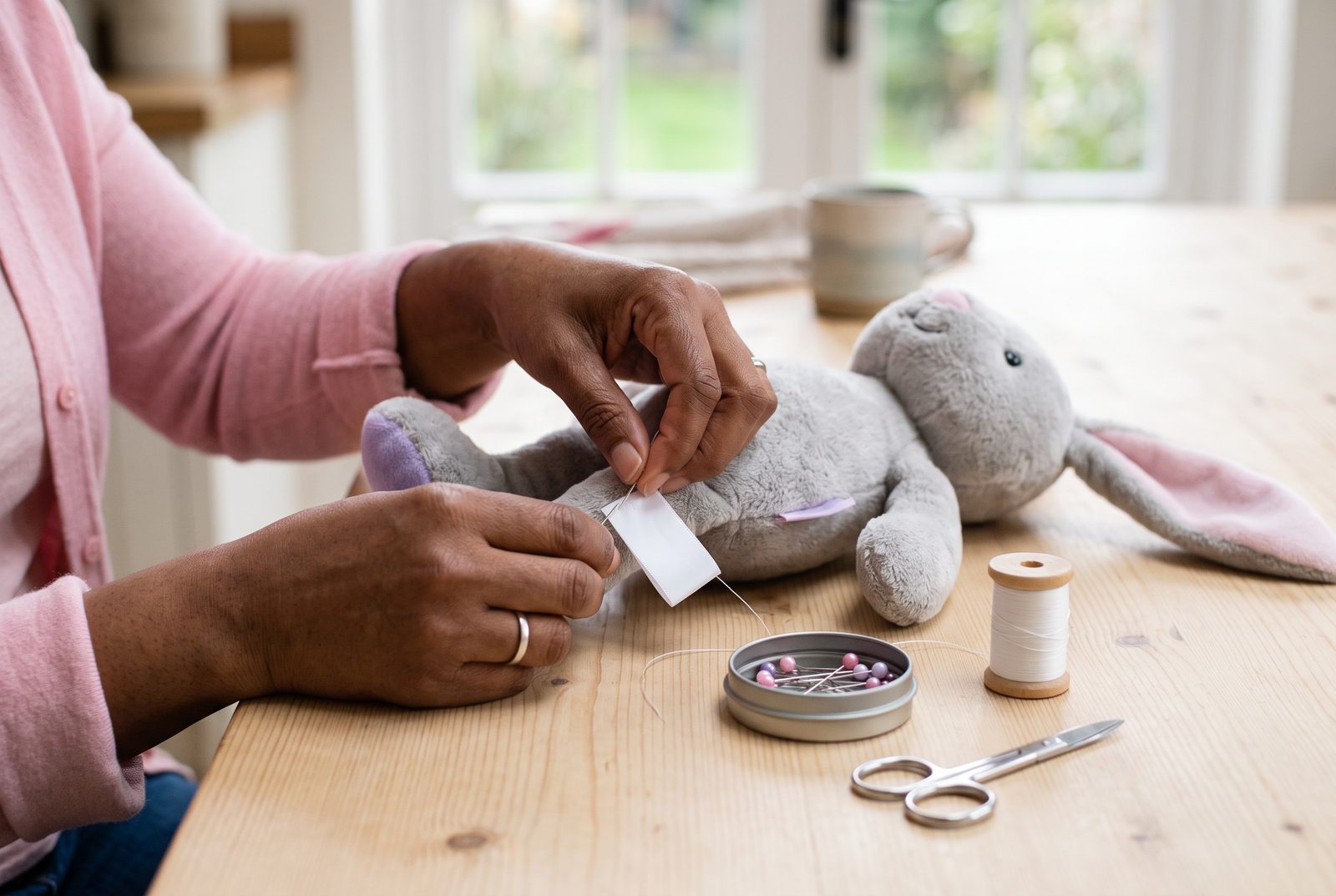
If it really is lost, say so simply, without inventing a trip it would have to come back from. Let your child be sad: it is real grief, to be taken seriously. Offer a replacement without pushing it, ideally the same model, and give it time: some adopt it in a night, others take weeks, others choose a new one themselves.
How do you help a child give up a comfort blanket?
By letting it happen. The comforter fades when the child finds other ways to feel safe: words to say they are upset, friends, the routine of school. Taking it away by force does not make a child grow up faster; it removes a tool just when they need it most.
You can help in small steps, giving your child the choice. The comforter waits in bed during the day. It minds the house while your child goes to school. It has a place of its own, a box or a corner of a shelf, where it comes out on feverish nights or moving days. No bargaining, and never a comforter confiscated as a punishment.
And when it reappears after months forgotten, welcome it back without comment. A well-worn comforter gets mended rather than binned: our guide on how to repair a stuffed toy shows how to give it a few more years.
Frequently asked questions about transitional objects
What did Winnicott say about the transitional object?
The title of his 1953 paper gives the best-known phrase: the transitional object is “the first not-me possession”, something that belongs to the baby without being part of them. His most quoted line, “there is no such thing as a baby”, is about the bond between baby and parent rather than the object.
What is a transitional object for adults?
The same kind of object, kept or adopted later in life: a childhood teddy that still sits on the bed, a partner’s jumper on a trip, a soft toy bought after a move or a loss. Winnicott described the transitional object in early childhood, but plenty of adults hold on to something soft for comfort, and that is nothing to worry about.
Should the comforter go to nursery?
Yes, most nurseries accept one and it helps with naps and morning goodbyes. Once school starts, each class has its own rule, often a box or basket where it waits until rest time or home time. Sew in a name label, and remember to bring it home in the evening if it sleeps there too.
What if my child has several comforters?
Nothing special. Some children have two or three, each with its job: one for bed, one for the car, one for poorly days. It is even a safety net if one goes missing. Let your child hand out the roles, and wash them in turn so there is always one that smells of home.
Sources
Erkolahti R., Nyström M. (2009). The prevalence of transitional object use in adolescence: is there a connection between the existence of a transitional object and depressive symptoms? European Child & Adolescent Psychiatry, 18(7), 400-406. DOI: 10.1007/s00787-009-0747-7
Fortuna K., Baor L., Israel S., Abadi A., Knafo A. (2014). Attachment to inanimate objects and early childcare: A twin study. Frontiers in Psychology, 5, 486. DOI: 10.3389/fpsyg.2014.00486
Hood B.M., Bloom P. (2008). Children prefer certain individuals over perfect duplicates. Cognition, 106(1), 455-462. DOI: 10.1016/j.cognition.2007.01.012
Lehman E.B., Denham S.A., Moser M.H., Reeves S.L. (1992). Soft Object and Pacifier Attachments in Young Children: The Role of Security of Attachment to the Mother. Journal of Child Psychology and Psychiatry, 33(7), 1205-1215. DOI: 10.1111/j.1469-7610.1992.tb00939.x
Wolf A.W., Lozoff B. (1989). Object Attachment, Thumbsucking, and the Passage to Sleep. Journal of the American Academy of Child & Adolescent Psychiatry, 28(2), 287-292. DOI: 10.1097/00004583-198903000-00024