

Contents
- What kinds of talking teddy are there?
- Which talking teddy suits which age?
- Lullabies and white noise: how loud is too loud?
- Does a talking teddy help a baby learn to talk?
- Connected and AI teddies: what happens to your child’s voice?
- Button batteries and speakers: what should you check before buying?
- How do you look after a talking teddy?
- Frequently asked questions about talking teddy bears
- Sources
A talking teddy bear can play phrases recorded at the factory, repeat what your child says, carry a message in a loved one’s voice, sing lullabies or play white noise; connected models answer through the internet. To choose well, check the age on the box, a volume control, a battery cover held by a screw and, if it connects, what happens to the recordings.
It says hello, it sings, it does Granny’s voice an octave higher. Out of the wrapping paper, a talking teddy always gets a reaction. The trick is finding the one that suits the child’s age, and your ears.
What kinds of talking teddy are there?
Not every noisy soft toy talks in the same way. The difference matters for safety as much as for privacy.
Five ways a teddy can talk
teddy
Pre-recorded phrases
A squeeze of the paw or tummy sets off a few words or a song, always the same, recorded at the factory.
Repeating
A microphone picks up the child’s sentence and plays it straight back, usually squeakier. Nothing leaves the toy.
Personal message
A recording module keeps a few seconds of a loved one’s voice, which the child can replay as often as they like.
Lullabies and white noise
A sound box plays tunes, rain or a steady hush, often with a timer.
Connected or AI
Linked to an app, it sends the voice to a server and answers with a sentence made up on the spot.
In our shop you will mostly find soft toys that sing or soothe. Our range of musical soft toys brings together lullaby models, and our white noise soft toys offer calming sounds for bedtime.
The personal message is the most touching of the five: the voice of a grandparent who lives at the other end of the country, a nursery rhyme sung by Dad before a night shift. Handy with a needle? The module slips into a hook-and-loop pocket planned from the pattern stage, and our guide to making a soft toy takes you through it step by step.
Which talking teddy suits which age?
As with any toy, the age on the box comes first. The words “not suitable for children under 36 months” flag small parts, often the sound box and its batteries. The markers in the table come only after that.
| Age | What suits | What to avoid |
|---|---|---|
| 0 to 12 months | Lullaby or white noise, toy placed outside the cot, volume at its lowest | Any soft toy in the cot during sleep; sound played right against the ear |
| 1 to 3 years | A teddy whose box allows this age, which sings or says a few words when pressed | Reachable sound box, button batteries, small parts |
| 3 to 6 years | A repeating teddy, one that tells stories, a message recorded by a relative | No volume control, sound that starts by itself at night |
| Over 6 | A connected teddy, with you, settings chosen together | Microphone always on, app with no parental controls |
For a baby, UK safer sleep advice from the Lullaby Trust and the NHS is clear: the safest cot is a clear cot, with no soft toys, pillows or bumpers during sleep. The lullaby teddy goes on a chest of drawers or a shelf, away from the baby’s head, and you switch it on at bedtime.
Lullabies and white noise: how loud is too loud?
A white noise teddy can run for a long time, sometimes all night, near an ear only a few months old. Its volume matters more than its tune.
Researchers measured 14 infant sleep machines at full volume, at 30 cm, 1 m and 2 m, allowing for the ear canal of a 6-month-old. At 30 cm, all of them went above 50 dBA, the limit recommended for hospital nurseries. Three produced more than 85 dBA, a level that, kept up for over 8 hours, goes beyond what is accepted for an adult at work (Hugh et al., 2014).
Average sound level of toys with a speaker, by distance
The same toys, measured against the speaker, averaged 107.6 dBA; at 25 cm, they dropped to 82.5 dBA (Weinreich et al., 2013). A few centimetres make a big difference, and that is exactly the distance that disappears when a child presses the teddy to their cheek.
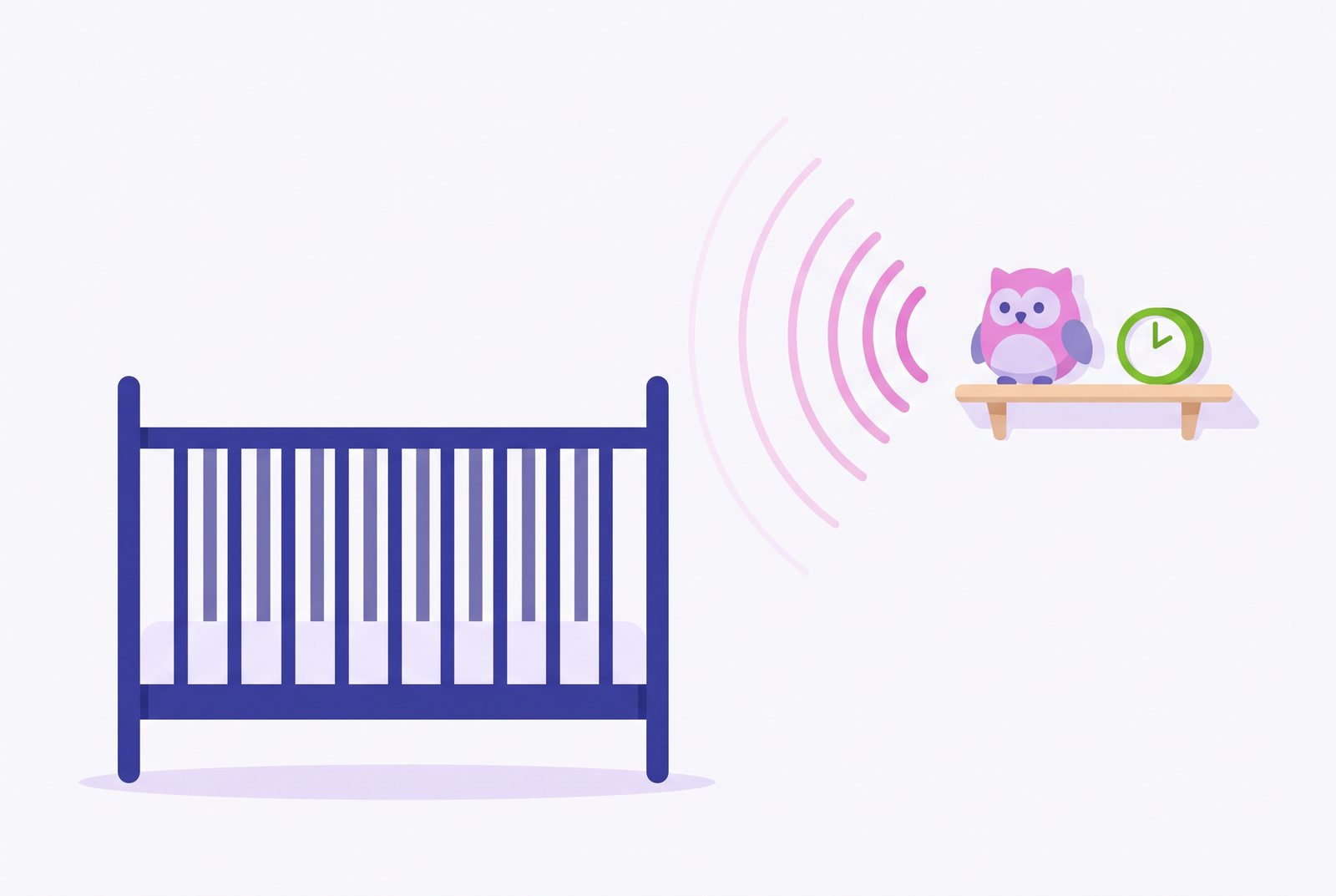
In practice, put the teddy as far from the cot as you can, choose the lowest volume that still works, and use the timer rather than playing on a loop. Test the sound at pillow height, not at hand height. If the toy is mainly there to help with sleep, our guide to choosing a soft toy for bedtime adds more tips.
Does a talking teddy help a baby learn to talk?
That is the promise on many boxes. The measurements point the other way, at least when the toy does the talking instead of the grown-ups.
One researcher observed 26 parents at home with their child aged 10 to 16 months, during 15-minute play sessions with electronic toys, traditional toys or books. With electronic toys, parents used fewer words, responded less often to their child, and back-and-forth exchanges were rarer. The children themselves vocalised less than with books (Sosa, 2016).
What the box promises, what the study found
On the packaging
- It teaches your baby words.
- It keeps them company in conversation.
- The more it talks, the better.
In the study
- Parents talked less with an electronic toy.
- Back-and-forth exchanges were rarer.
- Books got parents talking the most.
None of this rules out a singing teddy. Use it as a starting point: it sings, you name the animal, you copy its noise, you wait for your child to answer. Then switch it off now and then, to leave room for the stories you make up together.
Connected and AI teddies: what happens to your child’s voice?
A repeating teddy holds the sentence for a few seconds on its chip, then wipes it at the next word. A connected teddy usually sends the voice out of the house to build its reply.
The journey of a sentence spoken to a connected teddy
Researchers interviewed parents and children while they played with two connected toys. The children were often unaware that other people could hear what they said to the toy; the parents worried about privacy and wanted proper parental controls (McReynolds et al., 2017).
In the UK, the Information Commissioner’s Office applies its Children’s code to connected toys, talking teddies included, and expects them to come with tools that respect it. AI teddies add one more question: what they say back. The reply is generated on the fly, so it is unpredictable. Try it yourself, at length, before handing it to your child.
| Before switching it on | Where to look | Why |
|---|---|---|
| Where the recordings go | Privacy policy | To know in which country the voice is stored |
| How long they are kept | Privacy policy, app | A clear retention period should be stated |
| How to delete them | App, customer service | UK data protection law gives you a right to erasure |
| How the microphone turns off | Instructions, toy | To know at all times whether it is listening |
| How pairing works | Instructions | A code or a button to press stops a stranger connecting |
| Who gives consent | Account set-up | In the UK, a parent must agree for a child under 13 |
Button batteries and speakers: what should you check before buying?
Small teddies that repeat or sing often run on button batteries, the flat discs the size of a coin. They are the most dangerous kind if a child swallows one. Lodged in the oesophagus, a button battery can cause a serious burn within two to two and a half hours, and outcomes were far worse in children under 4 (Litovitz et al., 2010).
So the battery cover should close with a screw, and the Office for Product Safety and Standards says toys must keep button battery compartments secure. The speaker stays under the fabric, with no bare grille. If the sound box comes out, it sits in a closed pocket. A UKCA or CE mark and warnings in English appear on the toy or its box; the EN 71 standards set limits on toy noise, among other things.
Worried a battery has gone missing? Go straight to A&E or call 999, even if your child seems fine, and do not make them sick. For a toy that walks as well as talks, our guide to walking dog toys looks at remotes and their batteries.
How do you look after a talking teddy?
The sound module never goes in water. Through the opening, often a hook-and-loop strip on the back or under the tummy, take out the sound box, then wash the cover as its label says. Sound box sewn in? Clean the surface only, with a barely damp cloth, in the direction of the fur.
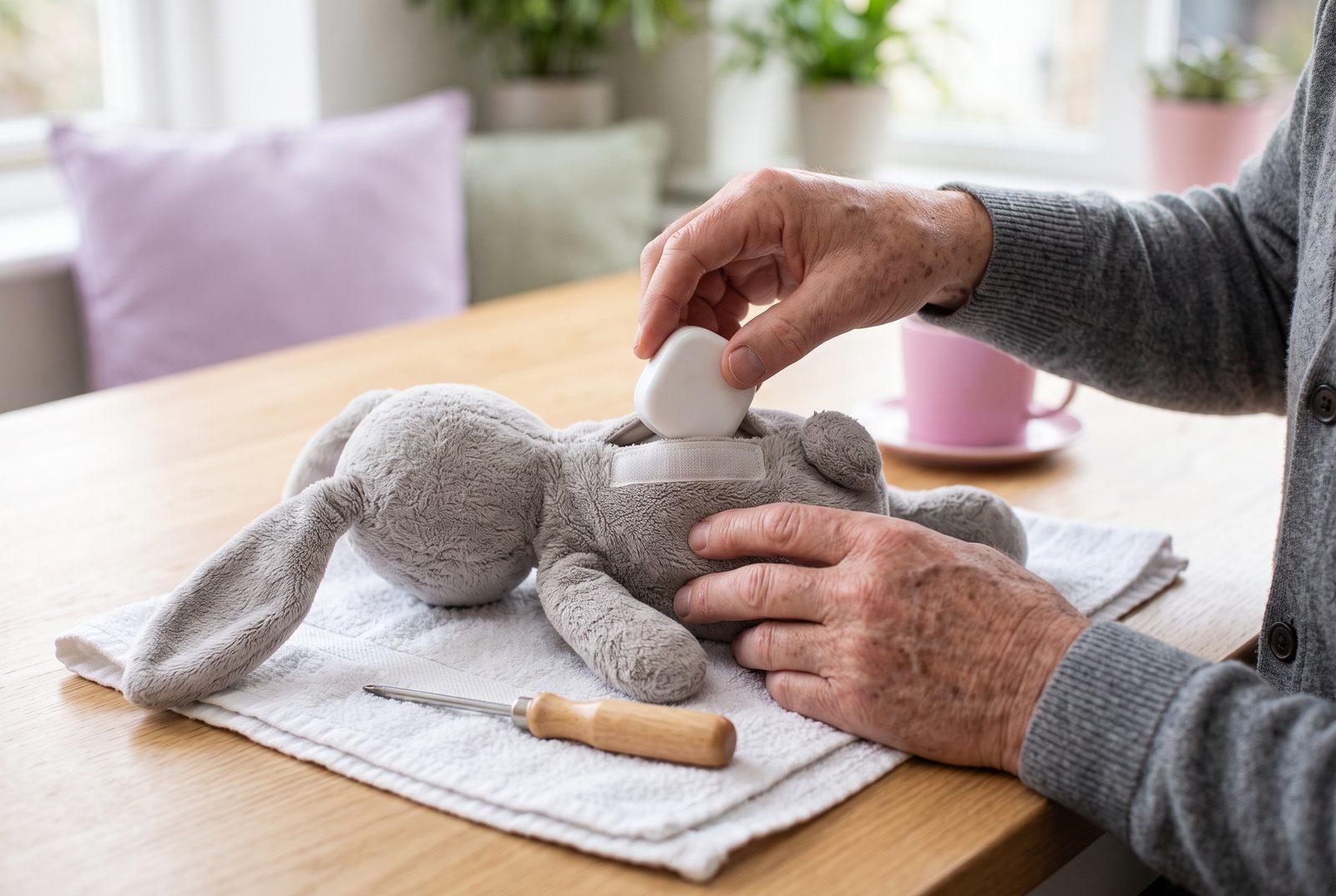
Let the teddy dry right through before putting the box back, otherwise damp corrodes the contacts. Take the batteries out if it is stored away for a few weeks, and never put used ones in the household bin. Every method, from the machine to dry cleaning, is in our guide to washing a battery or musical soft toy.
Frequently asked questions about talking teddy bears
Is it normal for kids to talk to their teddy?
Yes, it is very common. Many young children chat to a favourite teddy, give it a voice and act out their day with it, and this pretend play is part of growing up. A talking teddy can join in, but a silent one leaves the child to invent both sides of the conversation, which is no bad thing.
How do you put your own voice in a teddy?
Choose a teddy with a built-in recording module, or buy a module on its own: press, speak for a few seconds, and the voice stays until the next recording. Slip the module into a pocket closed with a hook-and-loop strip or stitches, never left loose, and check that its battery cover is held by a screw.
Does a talking teddy bear need wifi?
Usually not. Teddies with pre-recorded phrases, those that repeat, sing or play white noise all run on ordinary batteries with no connection at all. Only connected or AI teddies need an app, Bluetooth or wifi to answer, and those are the ones whose privacy settings deserve a careful look.
Why does a repeating teddy have such a squeaky voice?
The module plays the recording back at a higher pitch, often slightly faster. That is what gives the little cartoon voice that makes children giggle. A few models let you adjust the pitch, but most have no setting at all, so listen before you buy if you think it might grate.
Sources
Hugh S.C., Wolter N.E., Propst E.J., Gordon K.A., Cushing S.L., Papsin B.C. (2014). Infant sleep machines and hazardous sound pressure levels. Pediatrics, 133(4), 677-681. DOI: 10.1542/peds.2013-3617
Litovitz T., Whitaker N., Clark L., White N.C., Marsolek M. (2010). Emerging battery-ingestion hazard: clinical implications. Pediatrics, 125(6), 1168-1177. DOI: 10.1542/peds.2009-3037
McReynolds E., Hubbard S., Lau T., Saraf A., Cakmak M., Roesner F. (2017). Toys that listen: a study of parents, children, and internet-connected toys. Proceedings of the 2017 CHI Conference on Human Factors in Computing Systems, 5197-5207. DOI: 10.1145/3025453.3025735
Sosa A.V. (2016). Association of the type of toy used during play with the quantity and quality of parent-infant communication. JAMA Pediatrics, 170(2), 132-137. DOI: 10.1001/jamapediatrics.2015.3753
Weinreich H.M., Jabbour N., Levine S., Yueh B. (2013). Limiting hazardous noise exposure from noisy toys: simple, sticky solutions. The Laryngoscope, 123(9), 2240-2244. DOI: 10.1002/lary.23667