
Contents
- What are the benefits of sleeping with a teddy bear?
- Which sleep teddy suits your need?
- Which sleep teddy for a child?
- Is it normal for adults to sleep with a stuffed animal?
- What size and fabric for a bedtime teddy?
- How do you look after a teddy that sleeps with you?
- Frequently asked questions about sleeping with a teddy bear
- Sources
Sleeping with a teddy bear helps because touch reassures: a soft, familiar object makes letting go easier. Choose one that feels good to hold, the right size and washable. Then match it to your need: a weighted teddy that hugs back, a breathing one to slow your breath, white noise, a night light or a hot water bottle. No soft toy in a baby’s cot.
Few people admit it, but plenty of adults fall asleep holding something. Children make no secret of it. Between a plain teddy and one that breathes, warms up or hums, the right choice depends on what keeps you awake, and on who will be sleeping with it.
What are the benefits of sleeping with a teddy bear?
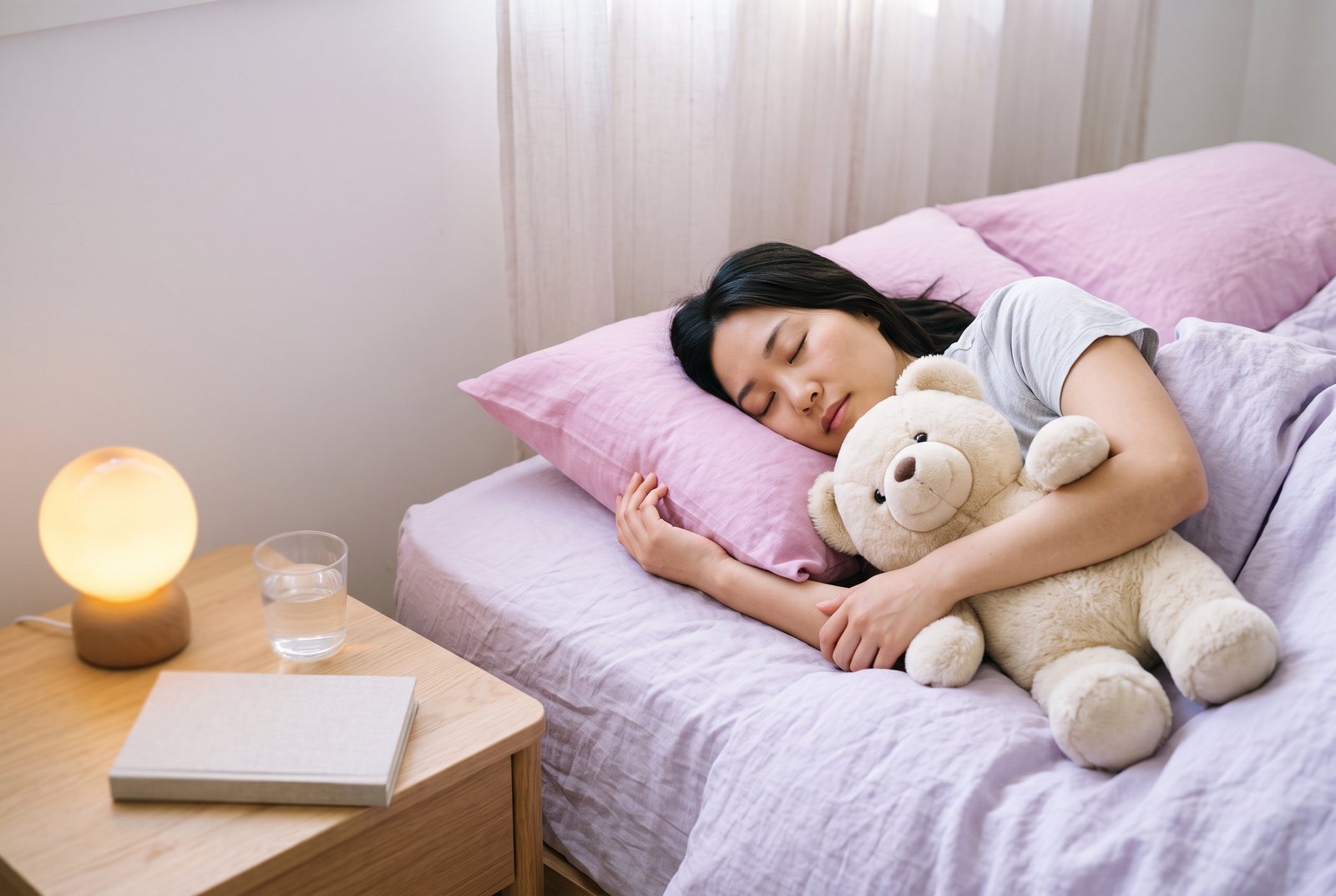
The main one is comfort through touch. Falling asleep means letting go, and the same soft object against you every night makes that moment familiar. The gesture becomes a cue to relax: teddy in your arms, time for bed.
A team of researchers set out to find what makes a teddy bear comforting. The strongest factor was the emotional bond with the toy; next came a mix of visual, smell and above all kinaesthetic traits, meaning how it feels when you touch and handle it. And the results did not depend on the participants’ age (Tribot et al., 2024).
So judge a soft toy with your hands: weight, squashiness, fur, the way it folds into your arms. And the most comforting one is often the teddy you already love, or the one you come to love by finding it every night.
What a teddy will not do is cure insomnia. If you have slept badly for weeks, your GP is the person to see.
Which sleep teddy suits your need?
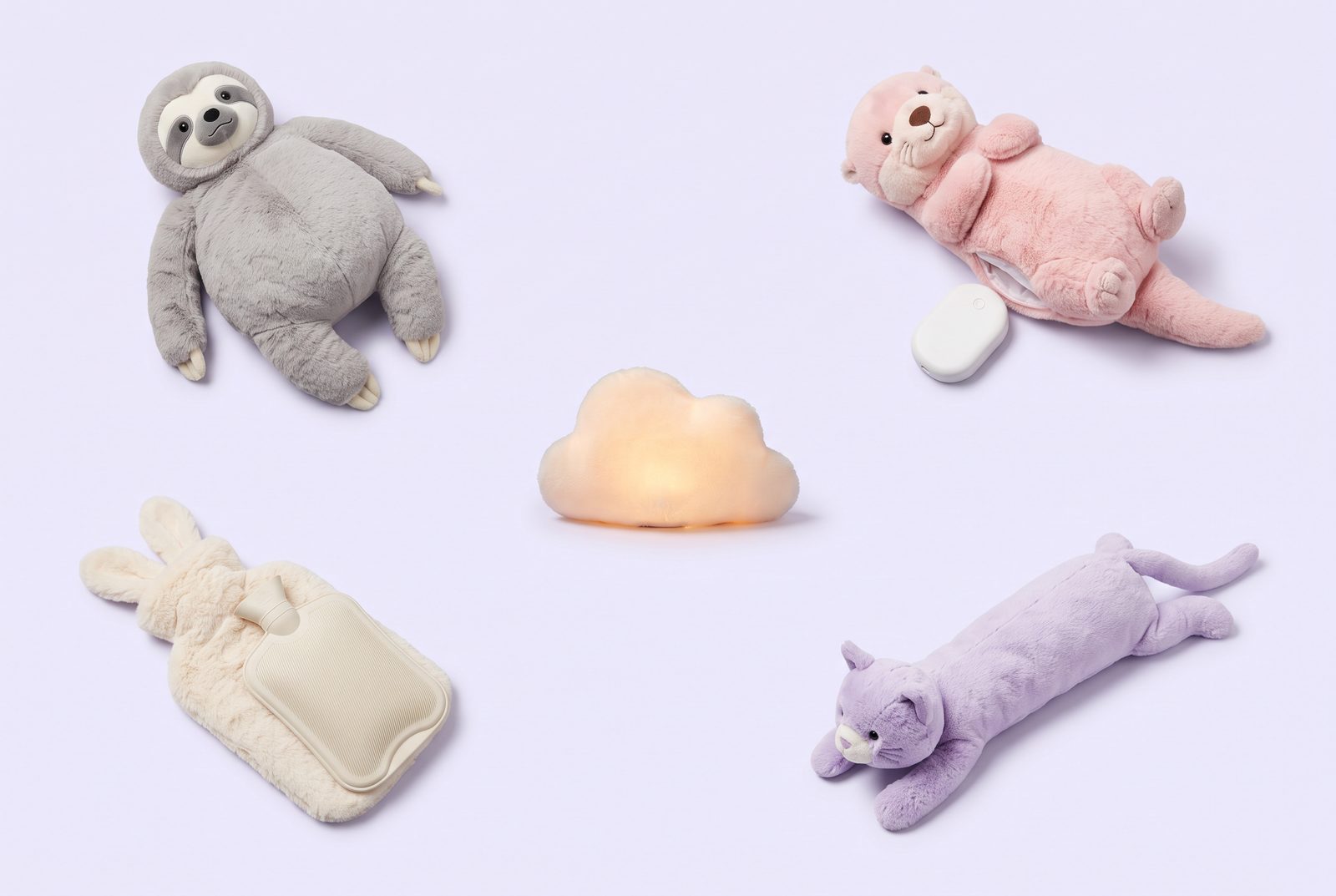
Six kinds of soft toy compete for bedtime. They do not promise the same thing, and they do not suit the same people.
| Type | What it offers | Who it suits | Watch out for |
|---|---|---|---|
| Plain teddy or cushion | Something soft to hold, with nothing to set | Everyone, children included from age 1 | Size that suits the bed, washable if possible |
| Breathing teddy | A tummy that rises and falls slowly, often with a lullaby | Adults and older children whose minds race at bedtime | Batteries, unit kept out of water, off once asleep |
| Weighted teddy | A weight that wraps around you and stills restlessness | Adults and older children who can push it off alone | Weight, never on the face, never for a baby |
| White noise teddy | A steady sound that masks household noise | Light sleepers, children bothered by noise | Low volume, away from the ear, timer |
| Night light teddy | A soft glow that makes the dark less scary | Children afraid of the dark | Dim light that fades or switches off by itself |
| Hot water bottle teddy | Gentle warmth on the tummy or feet | Adults and children who feel the cold, supervised for little ones | Never boiling water, not for a baby, instructions followed to the letter |
The plain teddy or cushion
The safest, and often the most effective, because people get attached to it. For an adult, a long soft toy or an animal-shaped cushion is hugged like a bolster, between arms and knees. For a child, a teddy of 20 to 40 cm stays in their arms without crowding the bed. Check that it washes: it spends its nights against a face.
The breathing teddy
A small unit makes its tummy rise and fall at a slow pace, often with a lullaby. Holding it close, you match your breathing to its rhythm. We found no published study testing it, yet many anxious sleepers like it for the minutes before sleep. Choose a breathing plush whose unit comes out, so the cover can be washed, and switch it off once you are asleep.
The weighted teddy
Glass beads or pellets, often in an inner pouch, give it weight. Laid on the tummy, chest or thighs, it gives a gentle pressure, like a firm hug. The published studies concern weighted blankets, not soft toys. Among 120 patients with depression, bipolar disorder, generalised anxiety or ADHD, a weighted chain blanket reduced insomnia more than a light blanket after 4 weeks (Ekholm et al., 2020).
A blanket that weighs on the whole body is not a toy you hug, and nothing says the effect carries over. A weighted plush remains a pleasant comfort object, for adults and for children old enough to push it off unaided. Never on the face, never for a baby: the Lullaby Trust lists weighted bedding among the things to keep out of a cot.
The white noise teddy
Rain, waves, a fan, a steady hush: white noise masks the sudden sounds that wake you, a door, a car, a snore. Many parents use it for babies, but the setting matters. Researchers tested 14 infant sleep machines at maximum volume: at 30 cm, every one exceeded 50 dB, the recommended limit in hospital nurseries, and 3 went above 85 dB (Hugh et al., 2014).
Run for more than 8 hours at that level, those 3 machines exceeded the noise exposure limits set for adults at work. A child sleeps for around 10 hours. Hence four simple rules: the lowest volume that masks the noise, never the maximum; the device as far from the bed as possible, never against the ear or under the pillow; a timer, so the sound stops once your child is asleep; and for a baby, the toy goes outside the cot. A white noise plush sits very well on a chest of drawers.
The night light teddy
For a child afraid of the dark, it makes the bedroom familiar. But evening light matters more than you might think for little ones. In 36 children aged 3 to 4, one hour of light before bedtime made melatonin, the hormone that prepares the body for sleep, drop sharply at every brightness tested, from 5 to 5,000 lux (Hartstein et al., 2022).
The average drop in melatonin measured in children aged 3 to 4 exposed to the dimmest light in the study, between 5 and 40 lux, during the hour before bedtime.
Hartstein et al., 2022, Journal of Pineal Research
So choose a night light as dim as possible, one that fades or switches off by itself after your child falls asleep. In our view, a warm amber or orange tone is less disruptive than bright blue. And a night light does not replace a calm, screen-free hour before bed.
The hot water bottle teddy
A hot water bottle slipped into a plush cover, or a heatable wheat bag, warms a cold tummy or feet. It is the most delicate of the six. Fill a hot water bottle with hot tap water or water that has cooled a little, never boiling, squeeze out the air and close it tightly. For a wheat bag, follow the heating time and power in the instructions exactly. Test the warmth on the inside of your wrist, give it to a child only lukewarm and under your eye, and never to a baby.
Which sleep teddy for a child?
It all depends on age, and the first rule fits on one line: under 1, the cot stays clear. The American Academy of Pediatrics advises putting babies to sleep on their back, on a firm flat surface, with no soft bedding (Moon et al., 2022). In the UK, the Lullaby Trust says the same, soft toys included: no soft toys or comforters in the cot, baby in a sleeping bag or under light bedding, in your room for at least the first 6 months. A white noise teddy or night light for a baby goes on a piece of furniture, at a distance.
After 1, a simple teddy can join the bed: no batteries, no cords, short fur, embroidered eyes. It is often the comforter, which plays a special part at bedtime; our article on why a comfort blanket matters to a child explains why. To check its safety, seams and eyes included, follow our guide on how to choose the right soft toy.
From about 3, soft toys with functions become useful, placed next to the bed rather than in it: a night light that switches itself off, white noise on a timer. The weighted teddy waits until your child is big and strong enough to lift it and push it off without help. Respect the minimum age on its label and product page.
Is it normal for adults to sleep with a stuffed animal?
Yes. The comfort a teddy gives does not depend on age (Tribot et al., 2024), and nobody stops needing softness on growing up. A soft toy helps through a break-up, a bereavement, a stressful patch or a hotel bed that feels too big, and for many it is part of a wind-down ritual, like herbal tea or a few pages of a book.
For an adult, size changes everything. A soft toy of 60 cm to 1 m, or a long one, is held between arms and knees and supports the shoulder when you sleep on your side. A small one slips into a suitcase and travels with you. If you share your bed, ask your partner’s opinion, and plan a spot for the teddy when it is not in use.

What keeps you awake, and the teddy that answers it
bedtime
need
Your mind races
A breathing teddy, to focus your attention on a slow breath.
You toss and turn
A weighted teddy, laid on the tummy or thighs.
Noises wake you
White noise, at low volume and away from the pillow.
You feel the cold
A hot water bottle teddy, warm not hot, cover closed.
You want a presence
A big or long soft toy, simple and washable.
Our guide on choosing a stuffed animal for adults goes through the models, sizes and fabrics that work best at night.
What size and fabric for a bedtime teddy?
Do the hands test, since touch is what comforts most. Close your eyes and hug it: it should fold into your arms without resisting, or slumping like an empty bag.
For fabric, a very soft short velvet pile, the minky type, stays pleasant against the cheek all night and washes well. Long faux fur looks lovely on the bed but is less comfortable against the face and slower to dry. If you run hot, avoid large, tightly stuffed models.
For size, think of the bed before the teddy. In a 90 cm single bed, a 1 m soft toy takes the space of a second sleeper. For a child, we suggest it is no longer than half the mattress and light enough to move alone. Listen to the mechanism too, as a motor hum you never notice by day is clearly heard in a silent bedroom.
How do you look after a teddy that sleeps with you?
A bedtime teddy spends hours against your face, so it needs washing more often than a shelf toy. Always remove the unit from a breathing, white noise or light-up teddy before it gets wet, and the weight pouch if it opens. Dry it right through, flat, before putting the mechanism or pouch back. A weighted teddy with sewn-in weight is hand washed or surface cleaned unless its label says otherwise. Every case, symbol and temperature is covered in our guide on how to wash a teddy bear. Wash a hot water bottle cover separately, bottle emptied and removed, and check the bottle itself each season: at the first crack or leak, replace it.
Frequently asked questions about sleeping with a teddy bear
When can a baby start sleeping with a teddy bear?
Not while they are a young baby. The Lullaby Trust advises no soft toys or comforters in the cot, and the American Academy of Pediatrics’ safe sleep advice covers the whole first year. Many parents introduce a simple, battery-free teddy at bedtime after the first birthday, short-haired and with embroidered eyes.
Does a weighted teddy help with anxiety?
It can feel soothing, like a weight on your lap or a firm hug, and many adults find it reassuring in the evening. No study has measured its effect on anxiety: the trials looked at weighted blankets. See it as a comfort object, and if anxiety is affecting your days or your sleep, talk to your GP.
Is sleeping with a stuffed animal a sign of trauma?
No. Nothing in the research we read links it to trauma. People who studied what makes a teddy comforting found the same effect at every age. A soft toy can help through a hard patch, but if you are struggling with your mood or your sleep, the right person to see is your GP.
Can you leave a breathing teddy on all night?
It is better used for falling asleep. If it has a timer, use it; if not, switch it off once you drift off. You save the batteries, and the unit does not hum or warm up against you until morning. For a child, keep the mechanism out of the bed during sleep and give them a battery-free teddy.
Sources
Ekholm B., Spulber S., Adler M. (2020). A randomized controlled study of weighted chain blankets for insomnia in psychiatric disorders. Journal of Clinical Sleep Medicine, 16(9), 1567-1577. DOI: 10.5664/jcsm.8636
Hartstein L.E., Diniz Behn C., Akacem L.D., Stack N., Wright K.P., LeBourgeois M.K. (2022). High sensitivity of melatonin suppression response to evening light in preschool-aged children. Journal of Pineal Research, 72(2), e12780. DOI: 10.1111/jpi.12780
Hugh S.C., Wolter N.E., Propst E.J., Gordon K.A., Cushing S.L., Papsin B.C. (2014). Infant Sleep Machines and Hazardous Sound Pressure Levels. Pediatrics, 133(4), 677-681. DOI: 10.1542/peds.2013-3617
Moon R.Y., Carlin R.F., Hand I., Task Force on Sudden Infant Death Syndrome, Committee on Fetus and Newborn (2022). Sleep-Related Infant Deaths: Updated 2022 Recommendations for Reducing Infant Deaths in the Sleep Environment. Pediatrics, 150(1), e2022057990. DOI: 10.1542/peds.2022-057990
Tribot A.-S., Blanc N., Brassac T., Guilhaumon F., Casajus N., Mouquet N. (2024). What makes a teddy bear comforting? A participatory study reveals the prevalence of sensory characteristics and emotional bonds in the perception of comforting teddy bears. The Journal of Positive Psychology, 19(2), 379-392. DOI: 10.1080/17439760.2023.2170273