
Contents
- What is a reversible octopus plush?
- What do the two faces of the octopus mean?
- How do you use a mood octopus with a child?
- How do couples, housemates and colleagues use it?
- From what age can a child have a reversible octopus?
- Why are premature babies given octopus toys?
- How do you choose a reversible octopus plush?
- How do you wash a reversible plush?
- Frequently asked questions about the reversible octopus
- Sources
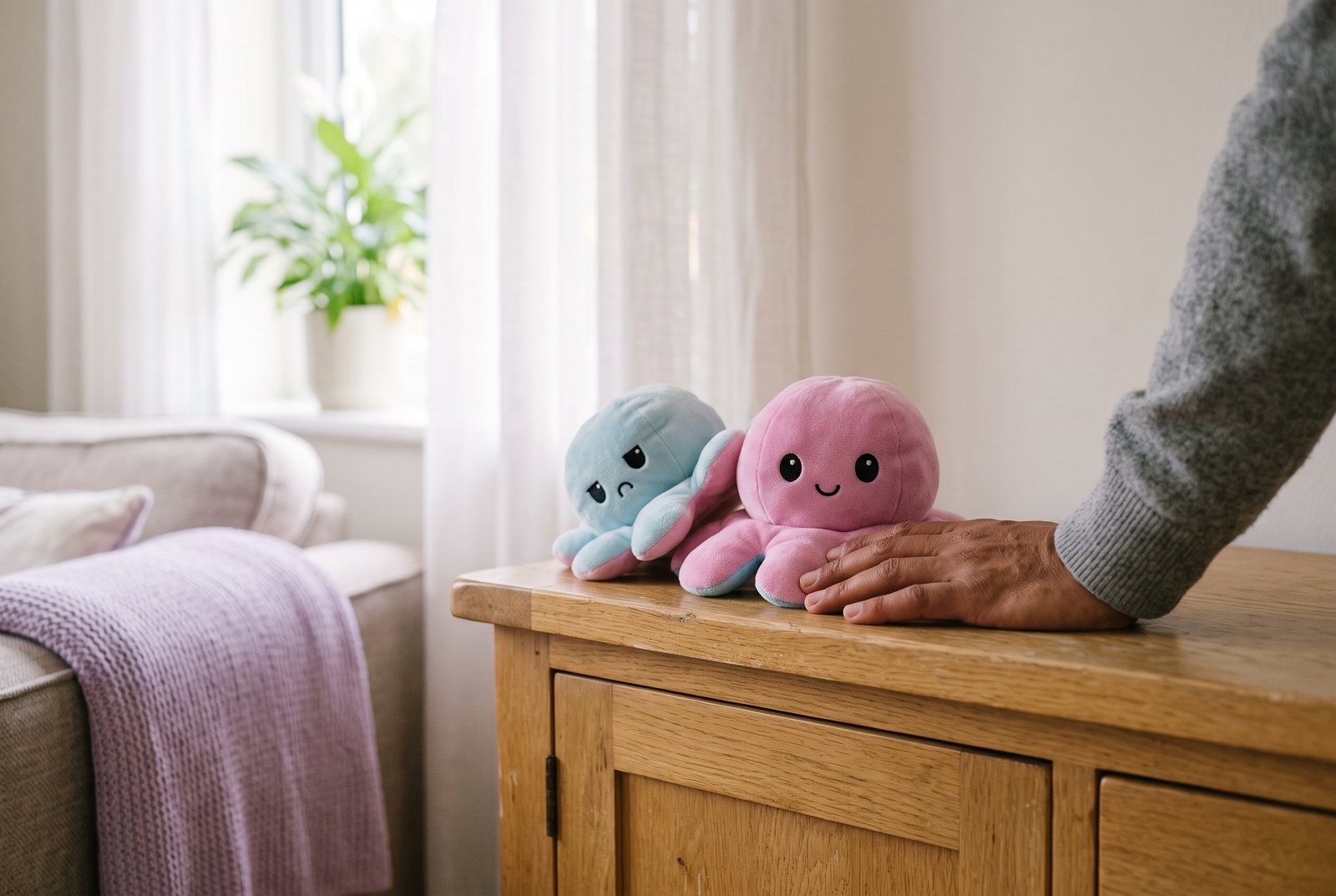
A reversible octopus plush is a small two-sided octopus: one face smiles, the other sulks, each in its own colour. You flip it inside out to show your mood without having to explain it. It helps a child who struggles to find the words, a couple, housemates or colleagues at the office.
It looks like a gimmick. Used well, it becomes a small conversation tool, one that will never do the talking for you.
What is a reversible octopus plush?
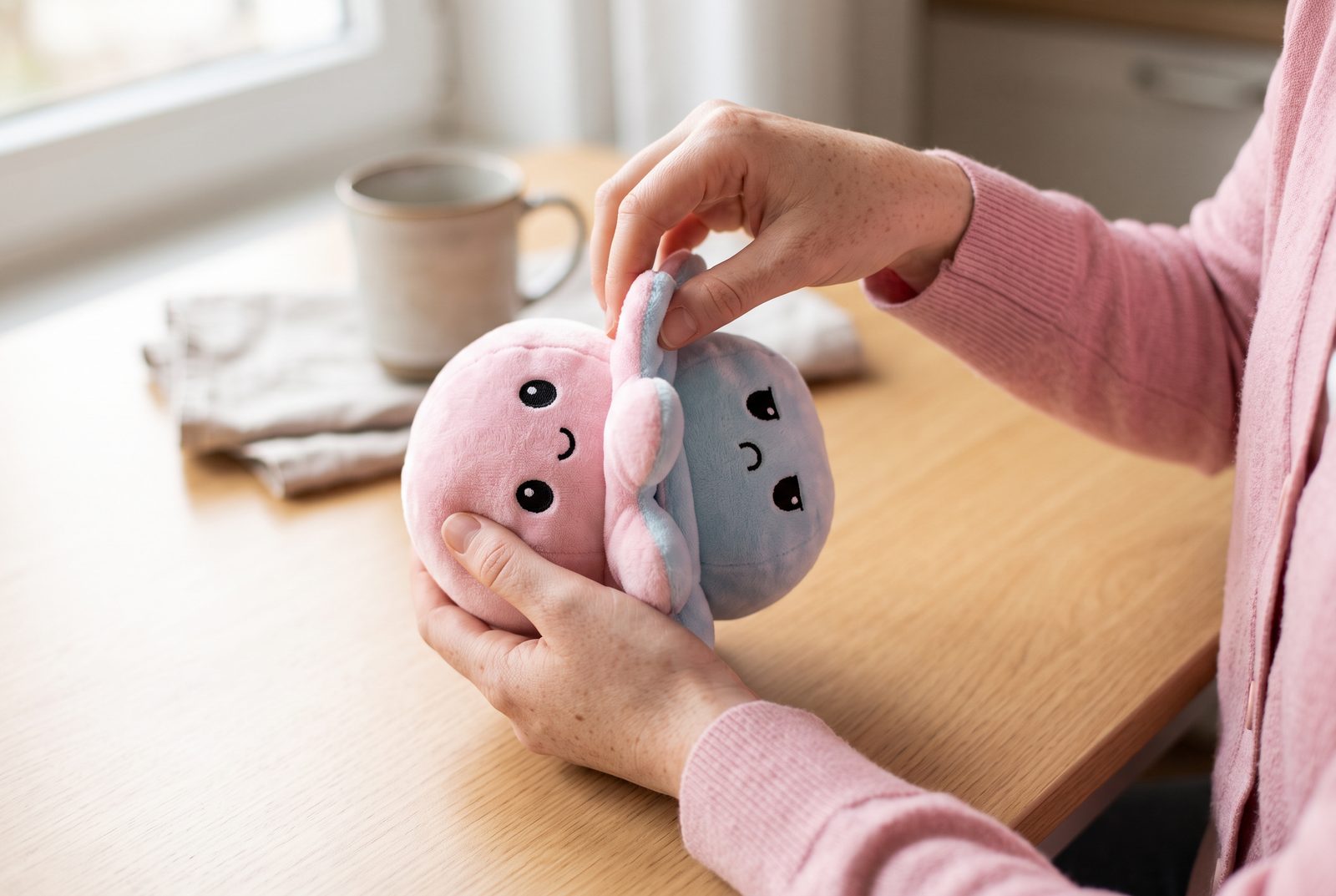
It is a round plush octopus with eight short tentacles. A seam runs around the edge of the tentacles and joins two faces: when you turn the toy inside out like a sock, the visible face goes inside and the other comes out. On the most common models, one face is happy and the other cross, in two sharply contrasting colours, pink and blue, yellow and purple, green and grey. Our octopus plush collection brings together reversible models and classic octopuses for cuddling.
It is also called a mood octopus, a flip octopus or a happy sad octopus. The craze started on social media in 2020: videos showed someone flipping their octopus instead of answering, and they went round the world. Since then it has settled on desks, beds and hall shelves.
There are also reversible soft toys of another kind, covered in sequins that change colour when you run a hand over them. They say nothing about mood: they are for stroking. Their care is different and is explained further down.
What do the two faces of the octopus mean?
What they mean is up to you. The toy only carries a smile and a pout; the exact meaning depends on what you agree together, and that is where it all happens. A cross face might mean “I am angry”, “I am tired” or “not now”. If nobody has said which, everyone reads it their own way.
The simplest approach is to set the code on a calm day, out loud, in a few sentences. Here are the versions that come up most often.
| Where | Happy face | Cross face | What to agree first |
|---|---|---|---|
| With a child aged 3 to 8 | All good, let’s play | Something is wrong | The adult comes and sits nearby, without demanding an explanation straight away |
| With a tween | Available | Need some peace | A delay, 1 hour for example, before talking about it |
| As a couple | Good day | Tough day | Who makes the first move, and that the octopus never replaces the conversation |
| In a shared house | Door open | Not in the mood to chat | Where it sits: on the hall shelf, outside a bedroom door |
| At the office | Feel free to interrupt | Concentrating, thanks | That the code stays light-hearted and the whole team knows it |
One detail matters more than you might think: what happens when the cross face appears? If it triggers an interrogation, the octopus will stay on its smiling side for good. If it brings a calm presence, a glass of water, a simple question, it will get used.
How do you use a mood octopus with a child?
A 4-year-old feels anger, jealousy or disappointment long before being able to name them. They cry, shout, shut down. The octopus gives them a halfway step: no words yet, but a gesture.
What the octopus makes possible, in three steps
Why go through a word? In adults looking at upsetting pictures, simply naming the emotion they felt lowered activity in the amygdala, a part of the brain that reacts to threat (Lieberman et al., 2007). In children, a meta-analysis found modest but consistent links between recognising and naming emotions, getting on better with others and having fewer behaviour problems (Trentacosta and Fine, 2010).
These studies are not about soft toys, and none shows that a reversible octopus changes a child’s behaviour. What they say is that naming feelings can be learned. The octopus is one support among others, like a book about emotions or a drawing.
Three tips to help it play that role. Model it yourself first: flip your own octopus on a tired evening and say why, and your child soon sees the code applies to adults too. Never flip it for them to make them laugh when they are angry, or they learn that their anger does not count. And keep it at their height, on the bedside table or a low shelf, so they can reach it alone.
In time, many children no longer need it and simply say “I am cross”. That is a good sign. The octopus then stays a bedroom soft toy, and sometimes an object they hold on to like a comforter, as our article on why a comfort blanket matters to a child explains. If your child never shows the cross face when everything suggests they are not OK, or if their outbursts become very frequent, talk to your GP. A soft toy does not fix distress.
How do couples, housemates and colleagues use it?
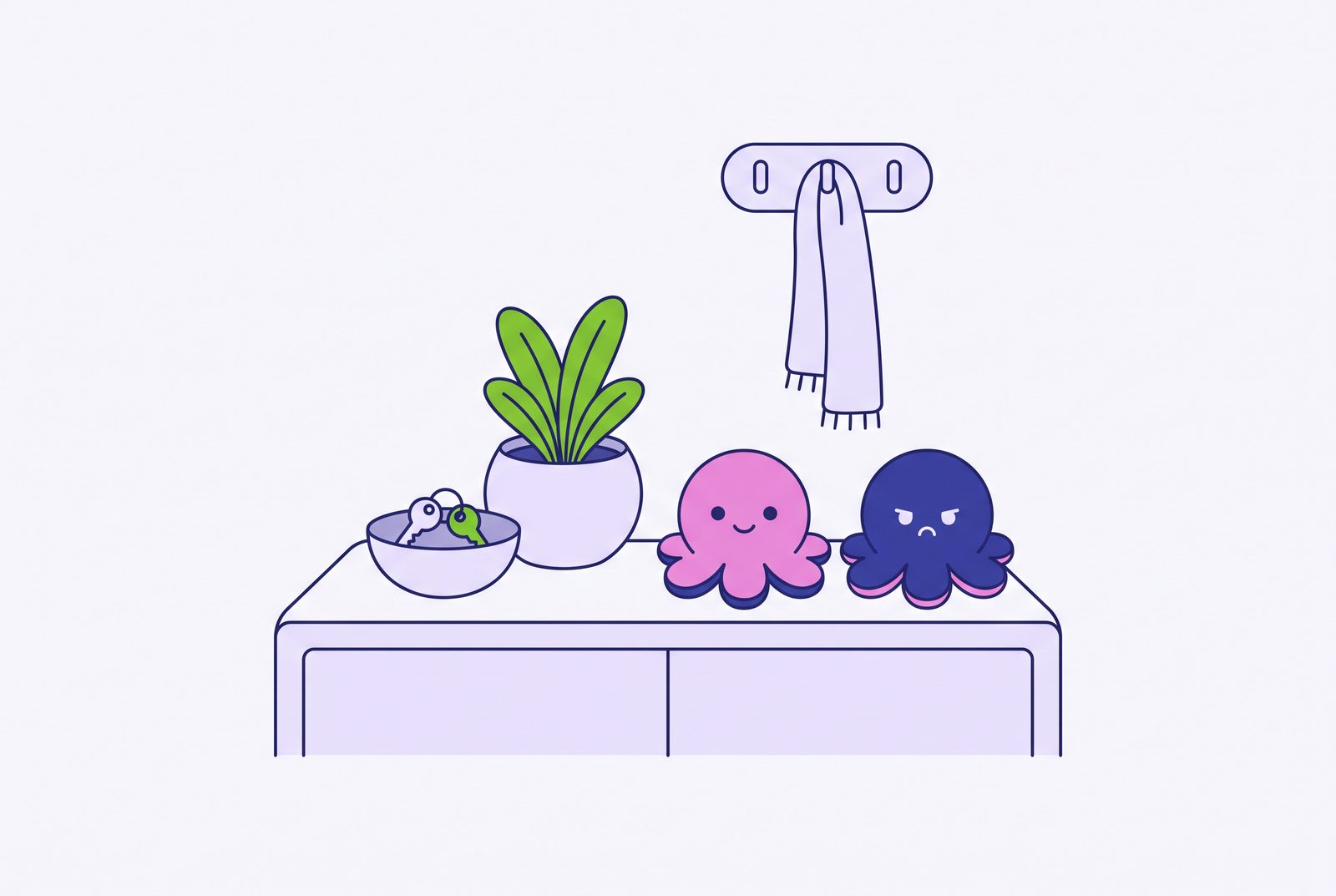
Adults usually have the words, but not always the energy to say them the moment they walk in. An octopus on the hall table passes the message on before the hello: the other person knows whether to tell their day straight away or wait until dinner.
As a couple
One octopus each, side by side. The cross face means “talk to me later”, never “sort yourself out”. It often gets flipped back with a laugh.
In a shared house
One octopus per person, outside their door or at their place at the table. It avoids misunderstandings without a house meeting or a group chat.
At the office
On the corner of a desk, it signals focus time. It works if the whole team takes it with a pinch of salt.
For couples, the golden rule is short: the octopus opens the door, it does not close it. If one of you shows the cross face, the other knows something is up, and the conversation comes later, when you are both ready. If the toy becomes a way of avoiding talking for days, it has lost its purpose. Take stock after 2 or 3 weeks of use: is the code still useful, does it need changing?
It also makes a small gift between partners, tucked in with a card for Valentine’s Day or an anniversary. For something more romantic, our Valentine’s Day plush collection gathers hearts and bears to give, and our guide on choosing a stuffed animal for adults helps you get it right.
From what age can a child have a reversible octopus?
To play the mood game, a child has to understand that a smile and a pout stand for something. From 3 or 4 years old, many children recognise a happy or cross face, and the game really makes sense around 5 years, when they start naming several emotions.
For safety, the age to follow is the one on the label and the product page. A toy with the crossed-out 0 to 3 symbol is not suitable for children under 36 months, often because of small parts or long fibres. Embroidered eyes hold better than glued or plastic ones. A plush keyring, with its metal ring and chain, is not a toy for a toddler.
For a baby, one simple rule: the Lullaby Trust advises no soft toys or comforters in the cot. The octopus waits on a shelf, where your baby can see it, not in the cot.
Why are premature babies given octopus toys?
This is the other octopus, and it is not reversible. Over 10 years ago, in 2013, volunteers in Denmark began crocheting small octopuses for neonatal units. The often repeated idea is that the baby grips the tentacles as it held the umbilical cord, and pulls less at its tubes. The project has spread to many countries, the UK included, where each neonatal unit decides whether and how to use them.
What we really know is more modest and more recent. One study followed 122 babies born before 36 weeks in a neonatal intensive care unit, in two successive groups of 61 children: one received usual care, the other a crocheted octopus given by the nurses during a blood test (Buzzi et al., 2026).
Average pain score during the blood test (PIPP, lower = less pain)
The result is encouraging, but it comes from a single unit, without randomisation. Above all, these octopuses follow strict rules set by each hospital: suitable cotton, high-temperature washing, short tentacles. Never make or give an octopus for a baby’s incubator without going through the care team. At home, the clear cot rule still applies.
How do you choose a reversible octopus plush?
Size matters more than colour. An octopus that is too big will not flip with one hand; one that is too small gets lost at the bottom of a bag.
| Format | Rough size | Who it suits | What to check |
|---|---|---|---|
| Keyring | Around 10 cm | Teenager, adult, school bag | Solid ring, not for under-3s |
| Classic | 15 to 20 cm | A child from the age on the label, a desk, a couple | Flips with a child’s hand |
| Large | 30 cm and over | Cuddles, bedroom decoration | Slower to flip and to dry |
Then pick two very different colours that read from a distance: a light face and a dark face can be spotted from across the room. On the product page, look for photos of both faces, the seam along the tentacles, the fabric and the stated age, as our guide on how to choose the right soft toy recommends. For a child, let them pick the colours if possible, as they take ownership of a code whose shades they chose. For a couple, two octopuses in different colours avoid any doubt over whose is whose.
How do you wash a reversible plush?
Always start with the label sewn under the tentacles. If it shows a washtub with a number, the octopus can go in the machine, inside a knotted pillowcase, on a delicate cycle at the temperature shown with a gentle spin. Otherwise, hand wash it in lukewarm water. Check the tentacle seam first: it works hard at every flip, and a weak stitch opens in the wash.
Drying needs care. The face turned inside dries more slowly, pressed against the stuffing. Lay the octopus flat in the shade and flip it every 2 or 3 hours so both faces dry right through. A 20 cm octopus often needs 24 hours. Once dry, a soft brush in the direction of the pile brings back its volume.
And sequinned reversible soft toys?
They are never soaked. The sequins are sewn or glued onto a fabric that copes badly with water, heat and the rubbing of the drum. Clean them on the surface, with a barely damp flannel and a drop of mild soap, smoothing the sequins all the same way. No tumble dryer, no radiator. Every other method, from the machine to bicarbonate of soda, is in our guide on how to wash a teddy bear.
Frequently asked questions about the reversible octopus
What are those octopus plushies called?
Reversible octopus plushies, also called mood octopuses, flip octopuses or happy sad octopuses. The first viral model belongs to one toy company, but the idea has been copied widely, so you will find many makers and sizes. Whatever the name, it is the same thing: a small octopus with two faces that you turn inside out.
Where can you buy a reversible octopus plush?
From a shop whose product page clearly states the dimensions, the fabric, the recommended age and the UKCA or CE mark. Look at photos of both faces and of the seam around the tentacles. A page that says nothing about age or care does not let you choose for a child.
What are some good names for an octopus plush?
Short names that are easy to say as you flip it: Inky, Ollie, Squidge, Octavia, Bubbles, Splash or Tentacles. Some families give each face its own name, a cheerful one for the happy side and a grumpier one for the cross side. Children remember the code better that way.
Which soft toys are trending right now?
Soft toys with a job are in fashion: reversible octopuses, weighted plushies kept on the lap, breathing teddies for bedtime. On the animal side, capybaras, axolotls and kawaii frogs follow social media. A trend passes; a soft toy you genuinely love stays.
Sources
Buzzi F., Ghizzardi G., Maiandi S. (2026). Use of crocheted octopuses for managing venipuncture pain in preterm infants: a prospective cohort study. Neonatal Network, 45(1), 50-56. DOI: 10.1891/nn-2025-0040
Lieberman M.D., Eisenberger N.I., Crockett M.J., Tom S.M., Pfeifer J.H., Way B.M. (2007). Putting feelings into words: affect labeling disrupts amygdala activity in response to affective stimuli. Psychological Science, 18(5), 421-428. DOI: 10.1111/j.1467-9280.2007.01916.x
Trentacosta C.J., Fine S.E. (2010). Emotion knowledge, social competence, and behavior problems in childhood and adolescence: a meta-analytic review. Social Development, 19(1), 1-29. DOI: 10.1111/j.1467-9507.2009.00543.x