
Contents
- Where do you start before buying teddy storage?
- Which teddy storage suits which space?
- What are the best floor-level storage ideas for soft toys?
- How do you store teddies up high safely?
- Which storage suits which age?
- How do you keep stored soft toys free of dust and dust mites?
- How do you store soft toys for months or years?
- Adult collections: how do you display them?
- Frequently asked questions about teddy storage
- Sources
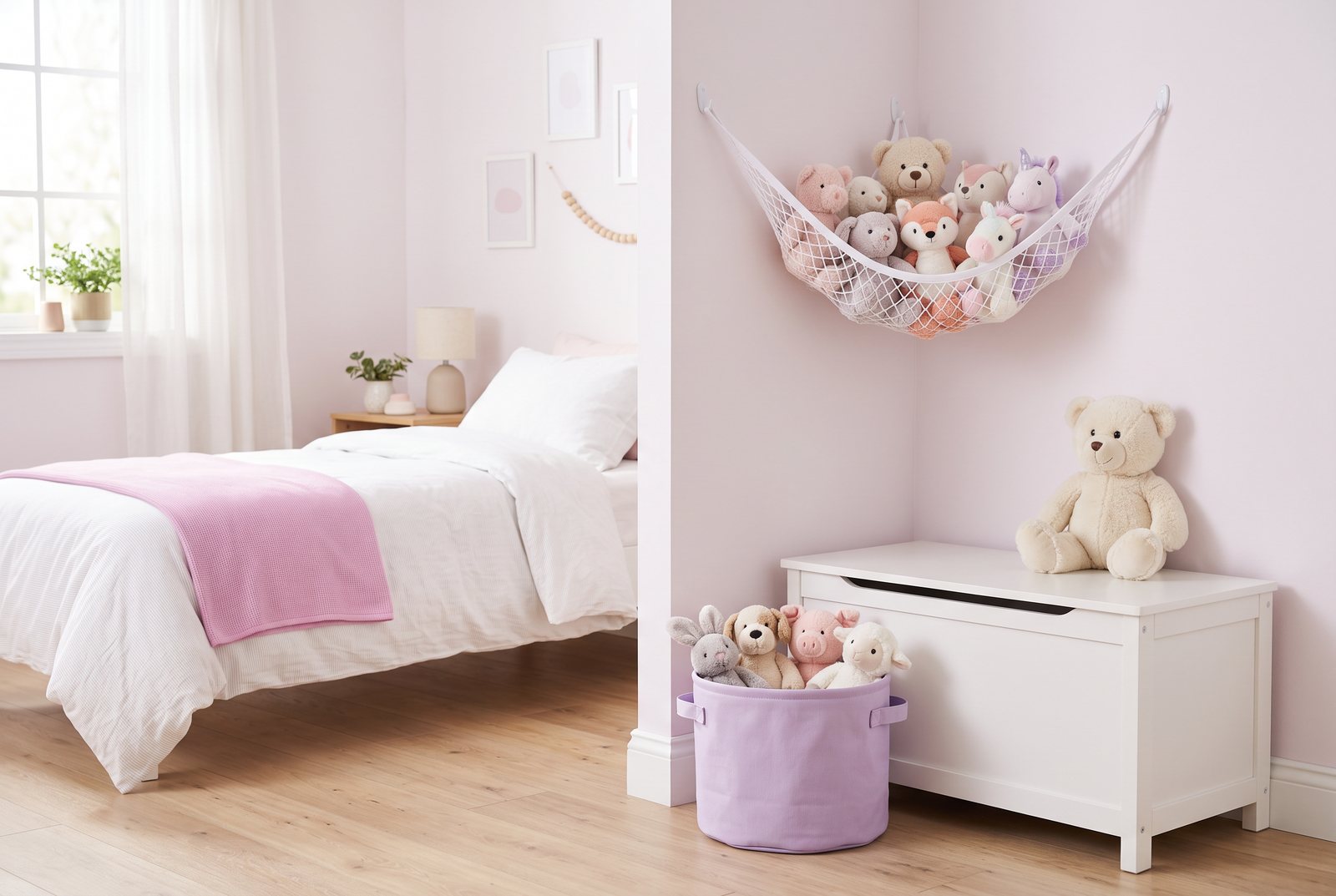
The best teddy storage ideas start with a sort, then match the space and the child’s age: a low basket or fabric box they can reach alone, a corner net or toy hammock to clear the floor, a wall shelf fixed to the wall for a collection. The favourites stay within reach; the rest go somewhere closed, away from dust.
Soft toys arrive with every birthday and every Christmas stocking, and almost none of them leave. One day the bed disappears under them. There is no single right storage, but three: one for the teddies that get cuddled, one for those that get looked at, and one for those you keep.
Where do you start before buying teddy storage?
With a sort, or even the nicest toy box overflows within a few months. Spread the soft toys out on the bed and give each one of these four destinations.
One soft toy, four destinations
shop second
Within reach
The comforter and the three or four teddies that get cuddled every week.
On rotation
The ones they like: stored out of sight, brought back out in a few weeks.
Keepsakes
A newborn’s first teddy, a present from a grandparent: clean, wrapped, stored apart.
Moving on
The ones nobody asks for any more: to donate, sell or recycle.
Do this sort with your child, never behind their back. To a young child, a soft toy is not interchangeable. In an experiment where a conjuring trick seemed to copy objects exactly, young children were far less willing to accept a perfect copy of their attachment object than of a favourite toy (Hood and Bloom, 2008). The comforter is therefore not up for discussion. For the rest, they choose what stays and you choose where it goes.
Rotation is worth a try. In a study with 36 participants, all toddlers, those given 4 toys rather than 16 played longer with each one, and in more varied ways (Dauch et al., 2018). In practice, leave a small selection out and swap it with the box in the wardrobe every 2 or 3 weeks: a forgotten teddy becomes new again.
The ones moving on can have a second life. Our ideas to donate or recycle stuffed animals keep them out of the bin.
Which teddy storage suits which space?
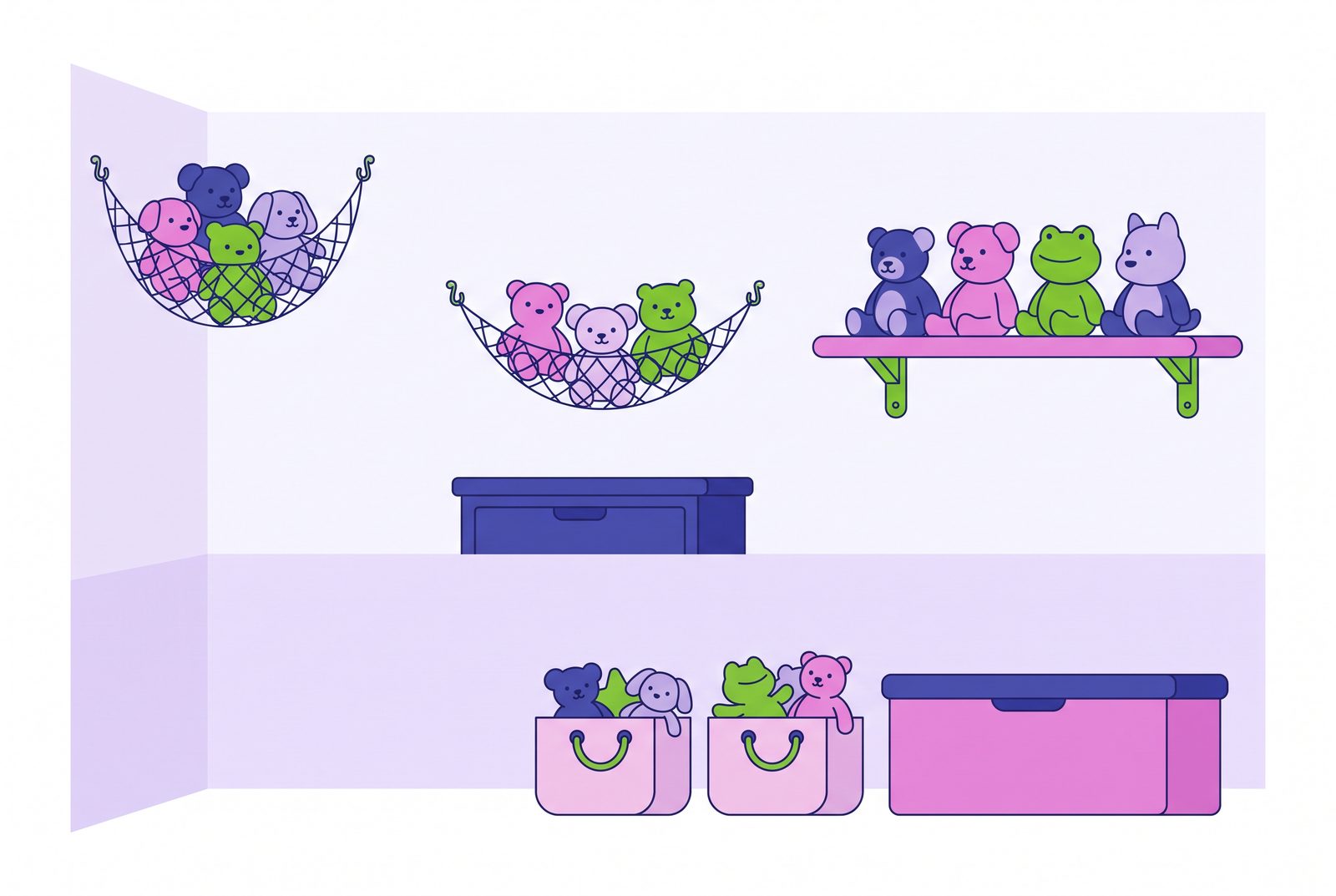
Each option trades off three things: the room it takes, how easily a child reaches it and how well it keeps dust off.
| Storage | Where it goes | Who tidies | Dust | Watch out for |
|---|---|---|---|---|
| Basket or fabric box | Floor, under the bed | The child, as soon as they walk | Toys exposed | The ones at the bottom, soon forgotten |
| Toy box | Floor, against a wall | The child | Protected, lid closed | A lid that drops and traps fingers |
| Storage bean bag | Floor, doubles as a seat | The child from about 3 | Protected | Squashed toys if overfilled |
| Storage bench | End of the bed, under a window | The child | Protected | A hinge that slows the lid down |
| Stretchy cord zoo | Floor | The child | Exposed | Slack cords |
| Corner net | High up in a corner | An adult | Exposed on every side | Fixings, never above a bed |
| Toy hammock | Above a chest of drawers | An adult | Exposed | Hooks that bend under the weight |
| Shelves or cube unit | On the wall | The child for the low cubes | Exposed, easy to dust | Always fixed to the wall |
| Over-door organiser | Back of a door | The child for the low pockets | Exposed | A door that strains to close |
| Lidded box | Under the bed, top of the wardrobe | An adult | Well protected | For rotation, not the comforter |
| Vacuum bag | Loft, wardrobe | An adult, for storage | Well protected | Flattened stuffing, never an old teddy |
Most bedrooms combine two: low, open storage for every day, high or closed storage for the rest.
What are the best floor-level storage ideas for soft toys?
On the floor, keep it simple: if tidying takes more than one movement, a child will not do it.
Baskets and fabric boxes
This is the storage that actually gets used: throw it in, pull it out, done. Choose one that is light, with handles, without a lid and low enough for your child to see the bottom. Two or three small boxes beat one big one, whose bottom becomes a graveyard of forgotten teddies.
Stick a picture on each box, animals in one and characters in another: a three-year-old reads a picture long before a word.
Toy boxes, storage bean bags and benches
Closed storage hides everything and keeps the dust off. Check the lid: it should stay open on its own, or come down slowly thanks to a soft-close stay. A heavy lid that slams shut traps fingers, and a child can climb into a large box, so choose one with air holes or a gap under the lid.
A storage bean bag, a cover you fill with soft toys, doubles as a seat. Do not overstuff it: a teddy squashed for weeks under an adult comes out flat.
Some soft toys need no storage at all: plush cushions live on the bench, the bed or the sofa with the other cushions, and take no room in the boxes.
The stretchy cord zoo
Wooden uprights joined by tight elastic cords: your child slips the soft toys between the cords, like animals in an enclosure, and can see all of them. Check the cords every 3 months, as they lose their stretch and snap back when they go.
How do you store teddies up high safely?
Up high, soft toys free the floor and become teddies to look at more than to cuddle, which suits the fragile ones.
Corner nets and toy hammocks
A net stretches across a corner on three fixing points; a hammock hangs above a chest of drawers. Either way, the fixing decides everything. A screw driven into plasterboard without the right wall plug will give way under twenty or so teddies, sooner if a child pulls on it. Use plugs made for your wall: plasterboard, brick or block.
Never fit a net or hammock above a bed, or within reach of a cot. A child standing up in a cot grabs anything that hangs, cords and mesh included.
Shelves, cube units and over-door organisers
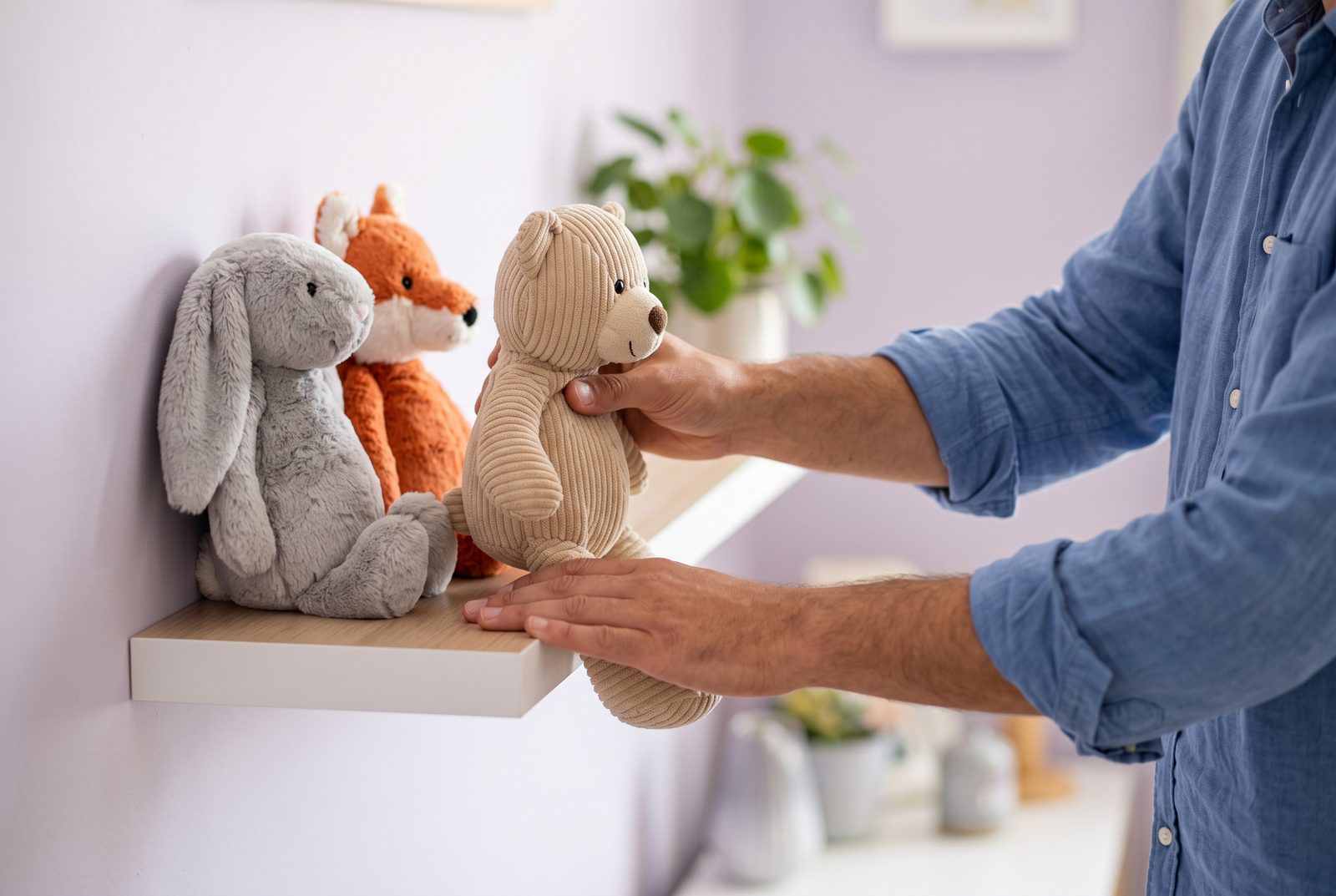
A shelf is always fixed to the wall, even a low one. This is not excessive caution.
children treated each year, on average, in American emergency departments after a piece of furniture or a television tipped over, between 1990 and 2019. Almost seven in ten were under 6.
Lu et al., 2021, Injury Epidemiology
A shelf full of teddies draws a small hand: your child steps on the bottom cube to reach the one at the top. Fit an anti-tip strap or bracket screwed into the wall, keep light toys at the top, and save the low cubes for the ones they are allowed to take alone.
An over-door organiser with pockets holds twenty or so small soft toys without taking an inch of floor. The bottom pockets belong to your child.
Which storage suits which age?
Good storage grows with the child. At 2 years, it must not hurt them; at 5 years, they should be able to tidy alone; at 12 years, the bedroom should no longer look like a nursery.
Under 3
Low, light, open boxes. No heavy lid, nothing hanging near the bed, no soft toys in the cot.
From 3 to 6
They tidy alone: boxes marked with a picture, low cubes, a few teddies on rotation.
From 7
Shelf, bench or net: they choose what is on show; keepsakes go into closed storage.
For a baby, the rule goes beyond storage. The Lullaby Trust and the NHS both advise a clear cot: no soft toys, pillows, bumpers or loose bedding. The American Academy of Pediatrics also recommends a firm, flat sleep surface without soft bedding to reduce sudden infant deaths and sleep accidents (Moon et al., 2022). Soft toys therefore sleep next to the cot, in a basket or on a shelf, not in it. To know when a comforter can join your child at night, ask your health visitor or GP.
The comforter has a fixed place, always the same one, so it can be found at bedtime without a search. Its role at each age is explained in our article on why a comfort blanket matters to a child.
From about 3 years, the aim changes: that they tidy up themselves. Show them once, tidy with them for a week, then let them do it, even crookedly.
How do you keep stored soft toys free of dust and dust mites?
A soft toy is a thick textile that stays in the same room for years. Of 40 children’s soft toys tested, every one carried dust mite allergens, at levels about 3 times higher than the same children’s mattresses (Wu et al., 2014). In homes with a cat, cat allergen on the toys was about 5 times higher than in homes without one: 2.49 against 0.48 µg per gram of dust.
From most exposed to best protected
Three habits are enough. Wash a soft toy before putting it into closed storage, following its care label, and wait until it is dry right through: our guide on how to wash a stuffed toy without damaging it covers each method. Keep the ones nobody cuddles in closed storage. Run the vacuum over the others, brush attachment and low suction, to lift surface dust.
Is your child allergic or asthmatic? Ask their GP which storage and how often to wash, and keep displayed soft toys well away from their pillow.
How do you store soft toys for months or years?
For long storage, cleanliness and dry air matter more than the container.
First, clean and dry right through, because a teddy put away damp smells musty when the box is opened. Take the batteries out of musical toys, night lights and breathing soft toys before packing them away, as the Recycle Your Electricals campaign advises: a battery forgotten for months can leak and eat into the casing.
Next, a plastic box with a lid rather than a cardboard one, which soaks up moisture and attracts insects, with a cotton pillowcase around each fragile teddy. Avoid a damp garage or shed and a loft that bakes in summer: the top shelf of a wardrobe does better.
A vacuum bag cuts the volume a lot, handy for a house move. A few weeks will not hurt a teddy filled with synthetic fibre, which plumps up again in the air within 1 or 2 days. Over months, the stuffing may stay flattened. Never vacuum-pack an old teddy, one in mohair or one stuffed with wood wool.
Clothes moths go for animal fibres: wool, mohair, felt. Open the box of an old bear every 6 months to check that no holes have appeared. Before putting it away, follow our method to clean an old teddy bear without soaking it.
Adult collections: how do you display them?
One shelf per theme or colour reads better than a wall covered from floor to ceiling. A glass-fronted cabinet keeps off dust and pet hair. Turn the collection round now and then: a teddy that always faces the window fades on one side.
Very large soft toys fit in no basket. A giant plush is treated like a piece of furniture: a corner of the sofa, a reading chair, the end of the bed, and the vacuum now and then. Measure the space before bringing one home, as a 1 m teddy sitting down takes up roughly the seat of an armchair.
Frequently asked questions about teddy storage
Is it normal to still sleep with a teddy as an adult?
Yes, and far more common than people admit. Plenty of adults keep one soft toy on the bed, often a childhood teddy. Treat it like any well-loved textile: wash it when its care label allows, let it dry right through, and give it a fixed spot on the bed or a shelf during the day.
What is inside a teddy bear, and does it change how you store it?
Most modern teddies are stuffed with polyester fibre, sometimes with a pouch of plastic pellets for weight. Older bears may hold wood wool, kapok or wool. Synthetic fibre recovers after a short squeeze in a bag; natural fillings do not, so an old bear goes in a box with room to breathe, never a vacuum bag.
What can I do with soft toys we no longer want?
Clean ones in good condition can go to a charity shop, a toy library or a nursery that needs them, if they accept soft toys. Check with your council before using a textile bank. Take the batteries out of musical or light-up toys first: the Recycle Your Electricals campaign says batteries must never go in the household bin.
How do you make DIY teddy storage?
The simplest is a stretchy cord zoo: a frame of wooden battens drilled through, with tight elastic cords threaded across, so soft toys squeeze between them. Quicker still, a sanded wooden crate laid on its side, or a net stretched between two hooks screwed into wall plugs suited to your wall.
Sources
Dauch C., Imwalle M., Ocasio B., Metz A.E. (2018). The influence of the number of toys in the environment on toddlers’ play. Infant Behavior and Development, 50, 78-87. DOI: 10.1016/j.infbeh.2017.11.005
Hood B., Bloom P. (2008). Children prefer certain individuals over perfect duplicates. Cognition, 106(1), 455-462. DOI: 10.1016/j.cognition.2007.01.012
Lu C., Badeti J., Mehan T.J., Zhu M., Smith G.A. (2021). Furniture and television tip-over injuries to children treated in United States emergency departments. Injury Epidemiology, 8(1). DOI: 10.1186/s40621-021-00346-6
Moon R.Y., Carlin R.F., Hand I., Task Force on Sudden Infant Death Syndrome, Committee on Fetus and Newborn (2022). Sleep-Related Infant Deaths: Updated 2022 Recommendations for Reducing Infant Deaths in the Sleep Environment. Pediatrics, 150(1). DOI: 10.1542/peds.2022-057990
Wu F.F., Wu M.W., Ting M.H., Crane J., Siebers R. (2014). Cat, dog and house dust mite allergen levels on children’s soft toys. Journal of Asthma, 51(1), 75-78. DOI: 10.3109/02770903.2013.843097